
US Army Long-Range Fires Expand Along First Island Chain Near China
Typhon has stayed in the Philippines for more than 30 consecutive months as HIMARS drills move closer to Taiwan
By AXY Defense Desk ·
Key points
- US Army long-range fires are now being used in exercises from the Philippines to Japan along the first island chain.
- HIMARS has moved to Itbayat, 100 miles from Taiwan, and to Balabac Island for its first live-fire there.
- Typhon has been in the Philippines for more than 30 consecutive months, while its Japan deployments have been stop-start with no official end date.
US Army soldiers are now training with long-range weapons from Balabac, a small island in the southern Philippines, to Hokkaido in northern Japan. The drills run along the first island chain, a line of islands that stretches past China's coast, and they are happening alongside allied forces in exercises that have grown larger and more complex over the past five years.
The newest word on the programme came from Gen. Ronald Clark, commander of US Army Pacific, who spoke at the Association of the U.S. Army's annual conference in Washington, D.C. Clark called the recent work "really a joint success story." Maj. Gen. Bernard Harrington, who also spoke at the conference, said the Typhon missile system sent to the Philippines "has maintained forward presence for now over 30 consecutive months."
The reason for all this training is China's growing missile force. The US military worries that China's larger and more advanced arsenal could keep American forces out of the Western Pacific during a conflict. The Army's answer has been to upgrade its existing missiles and rocket artillery and to develop new systems with longer reach. The source material describes the Army as having been freed from Cold War-era constraints, a reference to the limits on ground-launched missiles that the United States gave up when it left the Intermediate-Range Nuclear Forces Treaty in 2019.
Why Long-Range Fire Matters on the First Island Chain
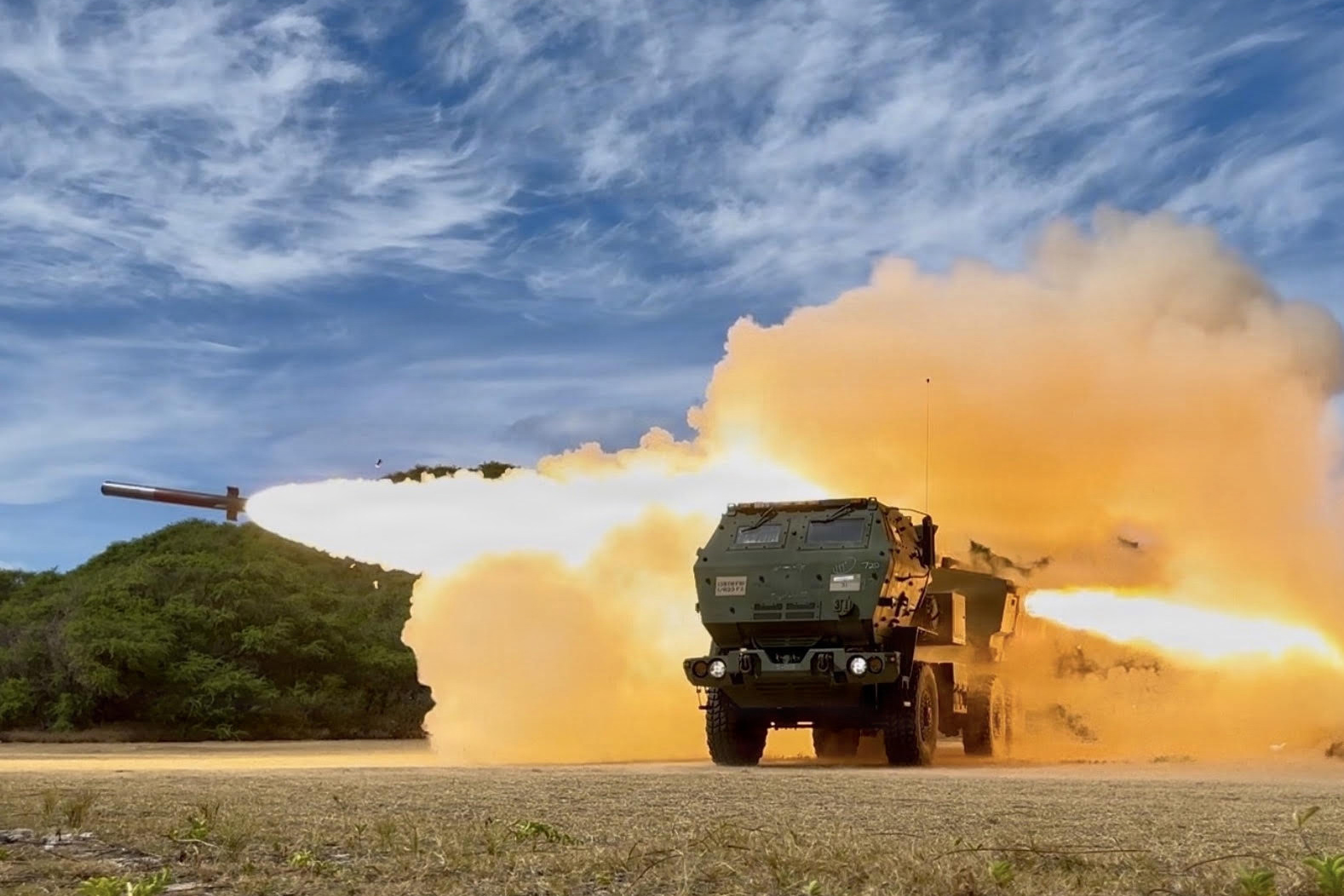
For most readers, the phrase "long-range fires" can sound abstract. It means the ability to hit targets far away with rockets and missiles fired from land. Here the phrase covers two main systems. The first is the High Mobility Artillery Rocket System, known as HIMARS. It is a truck-mounted launcher that can carry guided rockets with ranges of a few dozen miles, or ballistic missiles with ranges of a few hundred miles. It can be used for land-attack missions and for striking ships at sea.
The second is Typhon, a ground-based missile system that the Army calls its Mid-Range Capability. According to the source, Typhon can fire SM-6 missiles at air and sea targets a few hundred miles away, and Tomahawk missiles at land targets up to 1,000 miles away. From the Philippines and Japan, that reach covers large parts of China and Russia.
The practical point is simple. If allied forces can strike from islands along the chain, an adversary has to think about the cost of moving toward them. That is what Clark seems to be describing when he said the drills "gives them pause."
HIMARS Moves Across the Philippines
The Philippines has the longest history with HIMARS of the three countries covered in the source material. In recent years, US and Filipino troops have used it in new ways, including anti-ship strikes, and in new parts of the country. Exercises in 2024 and 2025 brought HIMARS to Palawan, which faces the South China Sea, and to the northern coast of Luzon, which faces Taiwan.
This year's Balikatan exercise, the largest annual drill between the two countries, showed how quickly the launchers can be moved. In April, US soldiers and airmen flew a HIMARS to Itbayat, the northernmost municipality in the Philippines, which sits only 100 miles from Taiwan. There the launcher carried out a dry-fire exercise, meaning a practice run without live rounds.
A few weeks later, an Army watercraft carried a HIMARS launcher to Balabac Island, south of Palawan, for the first live-fire exercise at that location. The Army said the drill showed the system's ability "to protect shipping going into the Sulu and Celebes Sea." Those waters carry commercial traffic, so the message reaches well beyond the military.
Clark pointed to another exercise as a model of how these moves are meant to look. Soldiers loaded HIMARS launchers onto aircraft at a base in Washington state and flew them to the Philippines. He said that step was visible to adversaries on purpose. "We then join munitions from Korea that were drawn out of stocks there to the Philippines, where our adversary could see it, and then we conduct a live-fire on the backend of a HIMARS rapid-infiltration operation," Clark said. He added: "Being able to do that, it, one, takes a lot of skill. Second, it takes a tremendous amount of partnership with, in this case, allies to assist us."
Japan's Shifting Typhon Deployments
Japan has also become a regular venue for these weapons. HIMARS first operated in Japan in 2021, during an exercise in Hokkaido. In 2022 it was deployed for the first time to Japan's Southwest Islands, which separate the East China Sea from the wider Pacific, for an exercise on an island northeast of Okinawa. Since then HIMARS has been a common feature of US exercises with Japan. The most recent was this year's Keen Sword, in which Army HIMARS were sent to a Japanese island only 150 miles east of Taiwan.
Typhon's path in Japan has been less settled. The Army sent a Typhon there for the first time in August 2025, for an exercise the following month. The weapon stayed until November that year. It returned this summer and was deployed to the southernmost of Japan's main islands for exercises in June and September. In October it moved to a base on Okinawa for storage.
The source material says that US officials told Tokyo the deployment is not meant to be permanent, but it has no official end date. That gap between a temporary mission and an open timeline is likely to matter to Japanese officials and residents who host the equipment.
Typhon's Long Stay in the Philippines
Typhon's first overseas deployment was to the Philippines in 2024, and it is still there. The source says the system was sent at Manila's request. Harrington's remarks put the length of that presence at more than 30 consecutive months, which makes it one of the longest forward deployments discussed in the material.
The system has also been used, not just stationed. In May this year, Typhon was test-fired for the first time, striking a target in central Luzon from nearly 400 miles away. That shot shows the Army is willing to demonstrate the weapon's reach in live conditions, not only on paper.
Harrington commands the recently established 7th Infantry Division/Multi-Domain Command-Pacific. The unit combines the ground-maneuver forces of the 7th Infantry Division with the long-range fires and non-kinetic effects of the 1st Multi-Domain Task Force. Non-kinetic effects cover actions that do not involve physical destruction, such as electronic or cyber operations. In practice, the command links fast-moving ground units with the heavy firepower that can reach far across the sea.
Where Typhon's Japan Mission Goes From Here
The next test for Typhon is whether Japan and the Philippines see the system as a lasting part of their defence or as a rotating visitor. In the Philippines, the 30-plus months of presence and Manila's request point to a longer relationship. In Japan, the stop-start pattern of deployment, storage and redeployment suggests a more uncertain plan. The lack of an official end date gives Tokyo and Washington room to adjust, but it also leaves questions open for local communities and for officials planning their own defence budgets.
The drills themselves are also growing. Balikatan, Keen Sword and the Japan exercises show allies practising moves that were once hard to imagine on a small island: moving launchers by air and sea, firing them live, and doing so where an adversary can see. Each new step makes the combined force harder to ignore, and it also raises the stakes of a misreading on either side. For now, the Army's own words suggest the aim is to show that the first island chain can hold fire at long range, and that allies can carry it out together.
Questions and answers
What is the Typhon missile system?
The source describes Typhon as a ground-based missile system that the Army calls its Mid-Range Capability. It can fire SM-6 missiles at air and sea targets a few hundred miles away and Tomahawk missiles at land targets up to 1,000 miles away.
Why is the US Army training with long-range weapons near China?
The US military worries that China's growing missile arsenal could deny American forces access to the Western Pacific during a conflict. The Army is upgrading existing systems and developing longer-range ones in response.
Is Typhon staying in Japan permanently?
According to the source, US officials told Tokyo the deployment is not meant to be permanent, but it has no official end date. The system was moved to a base on Okinawa for storage in October.
Topics: US Army, HIMARS, Typhon missile system, First island chain, Philippines, Japan, Gen. Ronald Clark, Army Pacific
Sources: Military Times