
US Army Competition Explores Military Uses for Humanoid Robots
Five companies won the xTechHumanoid competition, which tested whether human-shaped robots could support future military missions
By AXY Defense Desk ·
Key points
- The US Army named five winners of its xTechHumanoid competition: ACES Group, IHMC Robotics, Hydroplane Limited, Ras Labs and Velocity Explorations.
- Of 103 submissions, the Army selected 10 finalists, each receiving $25,000, before choosing winners in a live experimentation event.
- A researcher at IHMC Robotics said the competition's full requirements were beyond what current technology can achieve.
- Several companies focused on components such as batteries, fuel cells, software and tactile sensors rather than complete robots.
- The Army says the findings will guide research toward technologies offering the greatest return for warfighters.
The US Army has named five winners of a humanoid robot competition designed to test how human-shaped machines could support future military operations, according to an announcement dated Sept. 29 that Defense News reported. The winners of the xTechHumanoid competition are ACES Group, IHMC Robotics, Hydroplane Limited, Ras Labs and Velocity Explorations. The contest was run by xTech, the Army's program for accelerating new technologies.
Army chief technology officer Alex Miller said the service used the competition to identify "the problems, mission needs, and opportunities" where humanoid robots could be best used. He described xTech as a way of surveying the industry and fast-tracking promising technology "rather than falling victim to years-long studies." Miller also said humanoid robots are part of a broader autonomy push, which aims to expand the range of robotic platforms and components that industry can provide for different missions.
What a humanoid robot is and why the military is interested
A humanoid robot is a machine built with a body broadly shaped like a person's, typically with a head, a torso, two arms and two legs. The design is attractive to planners because it could, in principle, move through buildings, use doors, climb stairs and operate tools and vehicles built for people without major changes to the surrounding environment. Wheeled and tracked robots are usually simpler and more stable, so the humanoid form is generally considered harder to engineer, particularly when it comes to walking, balance and carrying loads over long periods.
Military interest in robots has grown over the past decade, mostly around uncrewed aircraft, ground vehicles and bomb-disposal machines. The appeal of autonomy in defense is usually framed around reducing risk to troops in dangerous jobs, such as clearing obstacles, carrying equipment or inspecting areas before people enter them. Humanoid robots are a newer and more ambitious branch of that effort, and the Army's competition shows the service is testing whether the approach is practical now or still years away.
How the competition was judged
The competition began with written proposals. Army officials reviewed a white paper, which is a detailed written proposal, from each company describing its humanoid robot. Officials evaluated the concepts against several criteria, including military utility, which is how useful a system would be to troops; technical merit, which is how sound the engineering approach is; and technological maturity, which describes how close a technology is to working reliably outside a laboratory.
Of 103 submissions, the Army chose 10 finalists, and each received $25,000. The service then picked the five winners through a live experimentation event, where the robots were tested in person. According to the Army's 2025 competition announcement, the event tested the robots on a series of collective tasks "in the context of a military small unit mission conducted in a combat situation." The use of a small unit scenario, meaning a group of soldiers working together on a mission, shows the Army was asking whether robots could function alongside people in demanding conditions rather than only in controlled demonstrations.
During the event, officials also reviewed two kinds of capability. Baseline system capabilities covered basic tasks such as checkpoint security, crossing gaps, clearing obstacles and firefighting. Advanced subsystems covered components such as thermal sensors, battery life and autonomy, meaning the robot's ability to act on its own without constant human control.
The gap between the Army's goals and current technology
The competition also exposed how far the technology still has to go. Robert Griffin, a senior researcher at IHMC Robotics, told Military Times that the individual requirements set out for the competition exceeded what current technology could achieve. "The individual things that were outlined were, in any one element, beyond what is possible given the current state of the art," Griffin said. He gave an example: "you don't have a robot that can run 28 miles an hour while carrying 50 pounds and operating for 24 hours. It's not a thing that exists in the world."
Griffin said the Army's full set of desired capabilities was beyond what can currently be done, so developers had to prioritise some elements of their robots' abilities over others for the demonstrations. His team focused on baseline capabilities. "The big thing for us was to have the robot show up at the competition, move around in the world, unsupported, at a reasonable pace, and then respond to commands," he said.
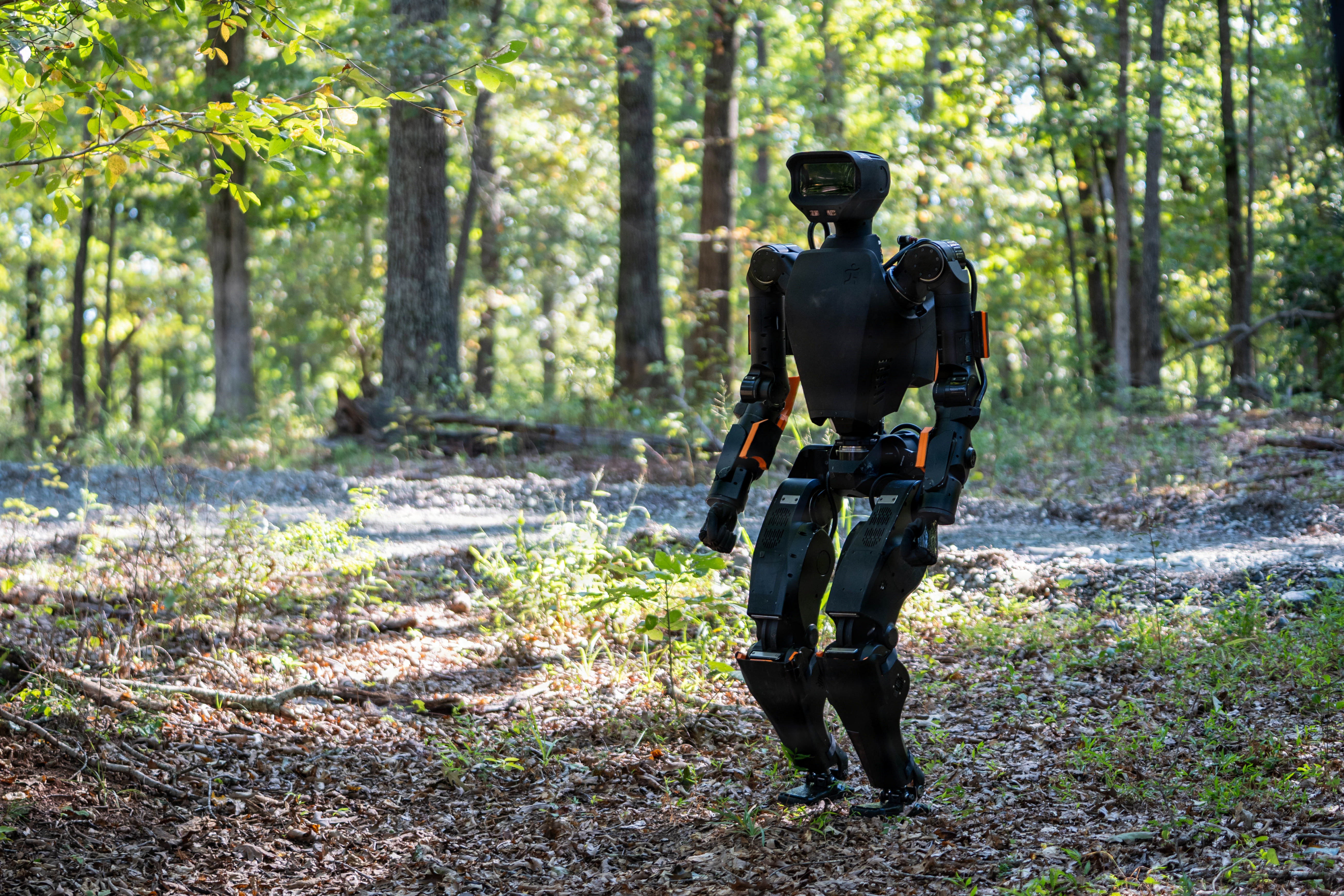
Video of the competition shows IHMC's robot, named "Alex," following voice commands to walk through a field and then, under the control of a human operator with a remote, move through woods and across gravel. The robot also grasped a small shovel and began to dig, then attempted to pour dirt into a bucket. It did not succeed at that task, but it demonstrated the movement. At the end of the video, Alex collapses and has to be carried out on a gurney. The footage illustrates both what the robot could do and how difficult the tasks remain for machines of this type.
Companies tested power, sensors and software
Not every competitor tried to show a complete humanoid robot. Several focused on subsystems, which are the individual components that a larger robot depends on. Hydroplane and ACES Group competed with their batteries. Velocity Explorations entered software that enabled its robot to listen to radio traffic between people, understand their movements and tasks, and use that information to build an understanding of the wider battlespace. Based on that picture, the platform could then decide how to act. Ras Labs tested highly sensitive fingertip tactile sensors, which measure touch and pressure, allowing a robot to handle delicate objects.
Dr. Anita Sengupta, founder and chief executive of Hydroplane, said her company has traditionally worked on large structures and aircraft, but has recently started developing smaller and portable systems. She said the company saw a strong overlap between developing a power system for a humanoid and for drones. "We saw a good overlap between developing a power system for a humanoid, whether it's a person or a robot, as well as the drone use case, so it just seemed like an interesting use case for us to take our technology to," she said.
For the competition, Hydroplane adapted a 10-kilowatt system that it had originally designed for the Marine Corps in 2024, making it smaller because the humanoid needed only a few kilowatts. The device uses a fuel cell, a device that generates electricity through a chemical reaction, similar in principle to the fuel cell used in some generators. Instead of diesel, however, it runs on hydrogen. Sengupta said the benefits include about three times the energy density and higher conversion efficiency. Energy density refers to how much energy a system can store for its weight or size, and conversion efficiency refers to how much of that energy becomes usable power. Hydroplane did not directly power a humanoid robot with its fuel cell. The Army tested it to see whether it could power one, and Hydroplane helped establish those standards, with the intent of eventually collaborating with a humanoid robot team.
What the Army says comes next
In its announcement, the Army said the competition gave it a clear picture of "both the progress commercial industry has made in humanoid robotics and the technical challenges that remain." The service said the findings will help it direct research toward technologies that offer the greatest return for warfighters.
The combination of progress and limits matters for the next phase. Companies that showed working parts, such as power systems, sensors and command software, may be able to offer those components to other programmes even if a complete humanoid robot is still far from field use. Griffin's comments suggest that the Army's highest demands, such as long endurance combined with speed and heavy loads, remain well beyond current capability, which means the timeline for deploying humanoid robots in combat roles is uncertain.
Readers should watch for how the Army converts these findings into funding, testing or procurement decisions, and whether the winning companies continue working with the service. The Army's statement describes the competition as a way to guide research, not as a commitment to buy specific systems, so the next concrete steps are not yet clear from the announcement.
Questions and answers
Who won the US Army xTechHumanoid competition?
The Army named five winners: ACES Group, IHMC Robotics, Hydroplane Limited, Ras Labs and Velocity Explorations. The announcement was dated Sept. 29.
What did the Army's humanoid robot competition test?
Officials reviewed written proposals against criteria including military utility, technical merit and technological maturity. Finalists then took part in a live event that tested robots on collective tasks in a simulated small unit mission.
Why did the robots in the competition struggle with some tasks?
A researcher at IHMC Robotics said the competition's individual requirements exceeded what current technology can do, so developers prioritised baseline capabilities. In the video of IHMC's robot, Alex, it failed to pour dirt into a bucket and later collapsed.
What happens next for humanoid robots in the US Army?
The Army said the findings will help direct research toward technologies with the greatest return for warfighters. The announcement did not specify purchases or deployment timelines.
Topics: US Army, humanoid robots, xTech, military robotics, IHMC Robotics, Hydroplane, Alex Miller
Sources: Defense News
https://axynewsglobal.com/article/us-army-competition-explores-military-uses-for-humanoid-robots