
Shehbaz Sharif Vows to Restore Progress in Khyber Pakhtunkhwa
Prime minister blames PTI for “callousness” as the federal government runs the province under governor’s rule
By AXY Pakistan Desk ·
Key points
- Shehbaz Sharif vowed in Peshawar on Thursday to bring back progress to Khyber Pakhtunkhwa, which the federal government now runs under governor’s rule.
- He blamed PTI for “callousness” and “criminal negligence” during its tenures in the province.
- He cited 5,000 unfilled police vacancies, incomplete Safe City projects and a CTD whose capacity he said had not been significantly enhanced.
- He said more than Rs800 billion had been provided or was being provided for KP since 2010, and made corruption allegations of Rs100bn and Rs37bn.
- The next tests are whether the promised resources reach police, security projects and development work, and how PTI responds.
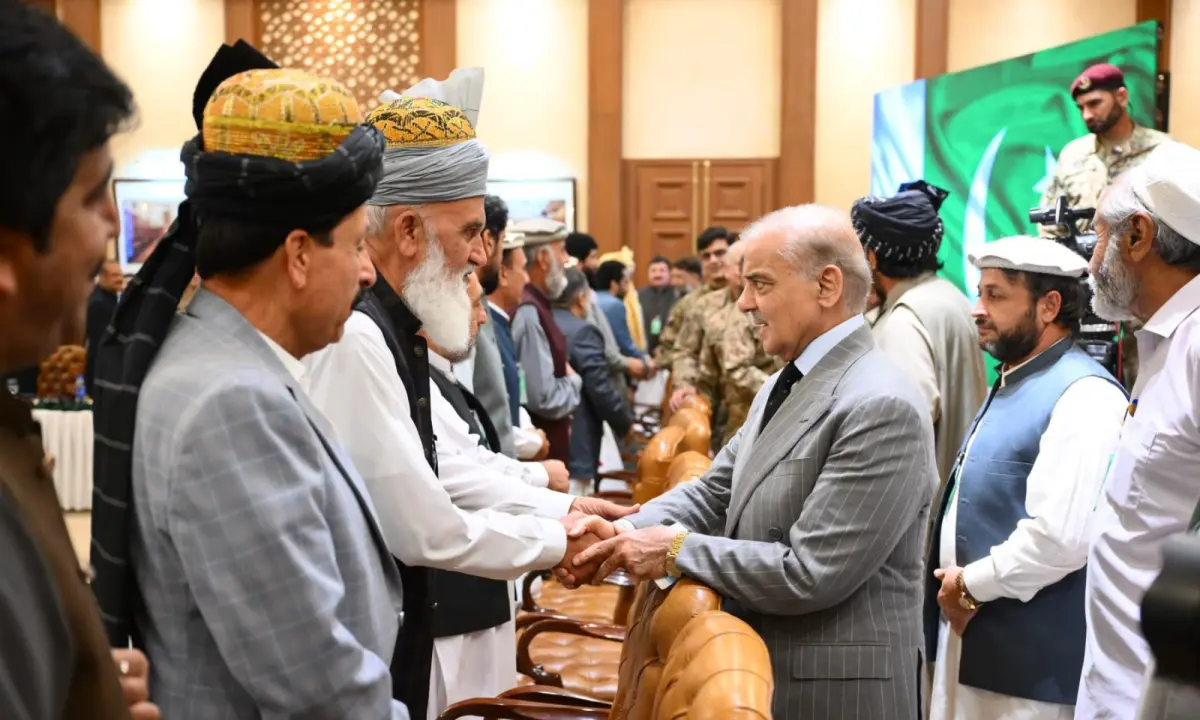
Prime Minister Shehbaz Sharif on Thursday vowed to bring back progress to Khyber Pakhtunkhwa, the northwestern province that the federal government now runs under governor’s rule. He made the promise while chairing a meeting of the apex committee in Peshawar, the provincial capital, and he used the same occasion to attack the Pakistan Tehreek-e-Insaf (PTI) party for what he called “callousness” during its time in power there.
The meeting was his first visit to the province since governor’s rule was imposed and an emergency was declared on Oct 11. It was attended by Chief of Defence Forces and Chief of Army Staff Field Marshal Asim Munir and by KP Governor Faisal Karim Kundi. The group reviewed the province’s overall security situation. Federal ministers and newly appointed provincial advisers were also in the room.
How Khyber Pakhtunkhwa Came Under Federal Control
Khyber Pakhtunkhwa, usually shortened to KP, borders Afghanistan and has been at the centre of Pakistan’s fight against militant violence for well over a decade. PTI has led the provincial government since the 2013 general election, which makes the province the party’s main base of power. That is why a move to take the province out of its hands carries weight well beyond one administration.
Governor’s rule is a constitutional arrangement in which the elected provincial government is set aside and the province is run by the federal government, acting through the governor. In this case, the change came with a declaration of emergency on Oct 11. The prime minister described the step as an interim handover of the province to the Centre.
He said the decision was taken “under extreme compulsion”. He recalled the breakdown of talks held on Oct 3, and said his government was “compelled to make this decision”. He also said that the government could not remain a “silent spectator” while a party, in his words, was stooping to such enmity against the country.
The prime minister brought up the former chief ministers Ali Amin Gandapur and Sohail Afridi. He said that he had assured the provincial governments of both men of the Centre’s full support in the fight against terrorism. “But nothing was done regarding this,” he said. He did not go into detail on what he meant, saying he would not go into the details.
Shehbaz Sharif’s Pledge to Restore Progress
The core of the speech was a promise. Shehbaz Sharif said the government would “leave no stone unturned” in bringing back what he called the happiness and era of progress to the province. He linked that promise to the wishes, aspirations and dreams of the people of KP, which he said had been shattered by what he called the worst actions of recent years.
He also said the Centre “will place all possible resources at your feet”. He named himself, the Advisory Council led by the governor, the president and the Chief of Defence Forces as the people who would ensure the province not only matches the other provinces in the race for development, but moves even further ahead. He said he would be extremely happy if that happened.
The pledge is broad. In the remarks reported so far, the prime minister did not name specific projects, budgets or deadlines. For residents, the test will be what arrives in schools, clinics, roads and police stations, and how soon it arrives. A speech can set a direction, but the people of KP will judge the promise by what they can see in their own towns.
The Police, Safe City and CTD Gaps the PM Listed
The sharpest part of the speech was aimed at PTI. Shehbaz Sharif said the party’s tenures showed “no worse callousness, criminal negligence, and hostility towards the national interest than this”. He told the committee that “all issues of the people were pushed aside”, naming education, healthcare, and protecting the lives and property of people, and that matters with terrorists had been put in their place.
To back up that charge, he listed specific gaps. He said 5,000 police vacancies had not been filled. He said Safe City projects were yet to be completed. Safe City schemes are generally urban surveillance and emergency response systems, typically built around cameras and control centres that police can use to monitor streets and respond to incidents. He also said the capacity of the Counter-Terrorism Department (CTD), the specialist police unit that handles terrorism cases, had not been significantly enhanced. Finally, he said special measures for police training had not been taken.
For ordinary residents, these are not abstract numbers. Unfilled police posts mean fewer officers on patrol and fewer staffing at checkpoints. Delayed Safe City projects mean fewer camera networks and emergency systems in towns and cities. A weaker CTD means fewer specialist officers available to respond to militant attacks and to extortion, which the prime minister said was taking place in several areas of the province.
Rs800 Billion Since 2010 and the Corruption Allegations
The prime minister also turned to money. He recalled that all provinces had agreed, at the time of the 2010 National Finance Commission Award, that Khyber Pakhtunkhwa, as the front-line region in combating terrorism, needed ample resources. The National Finance Commission Award is the formula that decides how federal revenue is shared between the centre and the provinces, so the agreement set out a basis for extra support to KP.
He said “from 2010 to today, more than Rs800 billion in funds have either already been provided or are being provided under this”. In his telling, the problem was not a lack of money. He said that “however, not only did it resurface, but the weapons needed to counter terrorism, the required capacity, and the trained officers needed were nowhere to be found.” Put simply, the prime minister argued that large sums had been spent without producing the equipment, capacity and trained staff the province needed.
He then made corruption allegations. He said there was corruption of Rs100bn in the clean drinking water component of the Cities Improvement Project. He also said Rs37bn was lost in what he called the “infamous looting” in a case involving the Kohistan District Accounts Office. These are allegations made by the prime minister at the meeting. The remarks, as reported, do not include a response from PTI or from the officials and offices named, so the claims stand as the prime minister’s own statements.
The figures are large, and they will be read in different ways. For the government, they support the case that KP’s problems were rooted in how money was spent. For PTI, the test will be whether it answers the specific allegations and the security figures, which will shape how the public weighs the prime minister’s account.
The Human Cost the PM Put on the Record
Shehbaz Sharif also described the human toll of the conflict in stark terms. He said “80,000 people were martyred” and that the economy suffered a loss of several hundred billion dollars. He said that “only then, in 2018, was peace completely restored in this country”. That date links his account to the period when militant violence in the north-west was at the centre of national politics, and it is the basis for his argument that the sacrifices made since then should not be undone.
He returned to the soldiers and police who had given up so much. He said young soldiers “left their homes and families to defend their country”. He argued that “there can be no greater enmity with the country than not honouring and respecting such sacrifices, not holding them in esteem.”
He made a further claim about what happened after peace was established. He said “terrorists were summoned back here”, and that this was “washing down all sacrifices down the drain.” He said the government could not remain a silent spectator while, in his words, terrorists were roaming around dancing in all areas of KP, ruling over some areas in the evening and collecting extortion. He set this against the stabilisation of Pakistan’s economy, which he said was being acknowledged globally.
These are strong words, and they are aimed at a political opponent. They also show how the government wants the public to understand the move: as a response to security and economic failure, not simply a change in who holds office.
What Governor’s Rule Means for Residents of KP
The prime minister’s argument links security and everyday public services. He said education and healthcare had been pushed aside while the province dealt with militant violence and the problems that came with it. He described the province as “very beautiful”, and said he hoped the government would “work hard day and night and speedily make it pr”, a sentence that was cut off in the material available, so the remainder of his remark is not reported here.
For families in Peshawar and other parts of KP, governor’s rule changes the chain of decision-making. Budgets, policing priorities and development schemes that would normally be decided by the provincial government now sit with the federal side and the governor. That can bring faster decisions and more money, but it also means local voters have less direct say over those choices while the arrangement lasts.
The prime minister has also made clear that the arrangement is meant to be temporary, describing the handover as an interim step. He called it “one last effort” to fix the province’s problems, which implies that the federal government sees this period as a deadline of sorts for results. That is an inference from his words, and the speech did not set a date for a return to elected government.
The Next Tests for Peshawar’s Federal Takeover
The next test is whether the promised resources reach the province in concrete form. The prime minister said the Centre would place “all possible resources” at the disposal of KP, and that is a pledge that can be measured. The clearest markers would be the 5,000 police posts he said were vacant, the completion of the Safe City projects, and a visible increase in the capacity and training of the CTD.
The second test is whether the government can show that the money already spent since 2010 produced results. The prime minister said more than Rs800 billion had been provided or was being provided. Residents and opposition politicians are likely to ask where that money went, and the allegations of Rs100bn and Rs37bn in corruption give them a specific place to start.
The third test is political. By blaming PTI in such detail, the government has put the party’s past tenures at the centre of the debate. PTI’s reply, and whether it contests the security figures and the corruption allegations, will shape how the public reads the move. The prime minister also asked for an “all-encompassing analysis as to why this happened”, which, if carried out, would be a review of how the province reached this point.
For readers outside KP, the case is a reminder of how closely Pakistan’s national politics and security questions are tied to the province. What happens in Peshawar over the coming months will show whether the federal government can turn its pledge of progress into practical change, or whether the debate stays focused on who is to blame.
Questions and answers
Why is Khyber Pakhtunkhwa under governor’s rule?
The province was placed under governor’s rule and an emergency was declared on Oct 11, with the federal government now running it. The prime minister said the step was taken under extreme compulsion after talks held on Oct 3 broke down.
What did Shehbaz Sharif say about PTI?
He said PTI showed “no worse callousness, criminal negligence, and hostility towards the national interest” during its tenures. He said education, healthcare and public safety were pushed aside in favour of dealing with terrorists.
What security gaps did the prime minister list?
He said 5,000 police vacancies were not filled, Safe City projects were not complete, the Counter-Terrorism Department’s capacity had not been significantly enhanced and special police training measures had not been taken.
What happens next in Khyber Pakhtunkhwa?
The prime minister said the Centre would place all possible resources at the province’s disposal. The next tests are whether those resources reach police, security projects and development work.
Topics: Shehbaz Sharif, Khyber Pakhtunkhwa, Governor's rule, PTI, Peshawar, Asim Munir, Counter-Terrorism Department
Sources: Dawn
https://axynewsglobal.com/article/shehbaz-sharif-vows-to-restore-progress-in-khyber-pakhtunkhwa