
Pentagon and BAE Sign Deal for Up to 25,000 APKWS Kits a Year
The framework agreement runs up to seven years and sets a path to 35,000 kits for allies, but Congress must still approve and fund the buy
By AXY Defense Desk ·
Key points
- The Pentagon signed a framework agreement with BAE Systems for up to 25,000 APKWS guidance kits a year for as long as seven years.
- Congress must still approve and fund the buy, and neither side has announced the cost.
- The framework outlines a path to 35,000 kits a year for U.S. allies as partner nations formally request them through Foreign Military Sales.
- APKWS converts unguided 2.75-inch rockets into laser-guided munitions, and the source describes it as a cheaper alternative to air-to-air missiles for shooting down drones.
- The Navy’s current APKWS contract with BAE is worth up to $1.74 billion and covers up to 55,000 kits, with work expected to finish by December 2031.
The U.S. Defense Department has signed a framework agreement with BAE Systems to buy up to 25,000 Advanced Precision Kill Weapon System, or APKWS, guidance kits a year for as long as seven years, the department announced on Monday, October 19, 2026. According to the department, the agreement is a broad arrangement on expected demand and terms, not a finished purchase. Congress still has to approve and fund the buy, the department said, and neither side has announced what the deal costs.
The framework is significant because it gives the defense industry a longer planning horizon for a weapon that has become a practical answer to a growing problem: how to stop inexpensive drones without firing costly missiles at every target. APKWS kits convert existing unguided rockets into laser-guided munitions, and the department says all four U.S. military services field them. The deal therefore touches on three questions that matter well beyond the Pentagon: how fast the United States can rebuild its stockpiles, how much it costs to defend against cheap aerial threats, and how allied countries will obtain the same weapons.
What the agreement covers
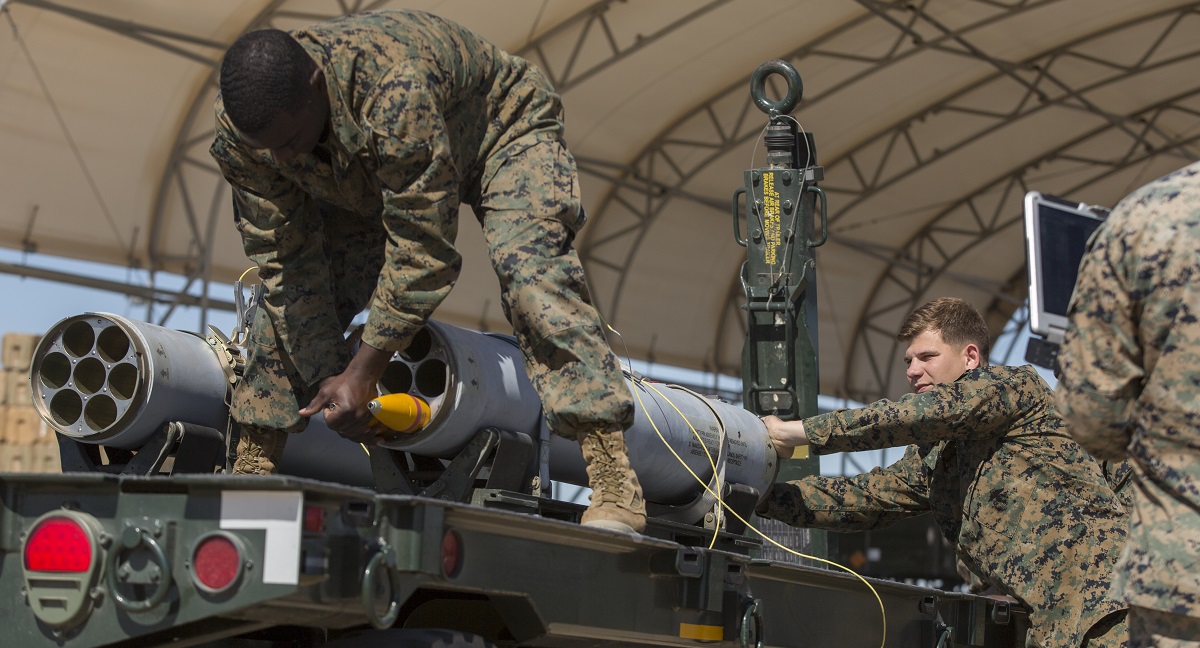
APKWS kits are guidance packages. They attach to 2.75-inch rockets, which are unguided, meaning they fly on a fixed path once launched and rely on the aircraft's aim and luck to hit a target. The kit adds a guidance section that homes in on a laser designation, so a rocket that would otherwise scatter across a wide area can be directed toward a specific point. The source describes the kits as converting unguided 2.75-inch rockets into laser-guided munitions.
The department’s announcement sets out a framework agreement rather than a single purchase order. The framework covers up to 25,000 kits a year for as long as seven years. BAE said it will increase production while the two sides work out a multiyear contract, which would be the more detailed, binding document that follows the framework and is expected to define the specific quantities, prices and schedules.
The framework also outlines a path to increase output to 35,000 kits a year for U.S. allies. The department said that added capacity will come online as partner nations formally request kits through the Foreign Military Sales program, the State Department and Defense Department process through which governments buy U.S.-made defense equipment. In other words, the higher allied figure depends on decisions by foreign governments, not on a guaranteed order from Washington.
In the announcement, Michael Duffey, the Pentagon’s undersecretary for acquisition and sustainment, said: “By securing multi-year demand, this agreement keeps production lines running at capacity, provides our forces with interceptor inventory, and flips the cost calculus in the taxpayer’s favor.” Tom Arseneault, president and CEO of BAE Systems Inc., said: “APKWS delivers proven, reliable and affordable precision at scale to counter evolving threats and ensure our warfighters maintain a decisive advantage.” Both statements emphasize steady production and cost, and both are the companies’ own characterizations of the deal.
How the deal fits into a wider munitions push
The APKWS agreement is part of a broader set of arrangements the Pentagon has pursued this year to expand weapons production. The source reports that in January, Lockheed Martin agreed to more than triple production of the Patriot Advanced Capability-3 Missile Segment Enhancement, or PAC-3 MSE, interceptor. The PAC-3 MSE is a surface-to-air missile used to defeat aircraft and short-range ballistic missiles. In March, BAE and Lockheed agreed to quadruple production of seekers for the Terminal High Altitude Area Defense, or THAAD, interceptor. A seeker is the sensor component that guides a missile toward its target, and it is one of the most demanding parts of a precision weapon to manufacture.
The source also notes a separate THAAD framework signed in January that led to a June contract worth more than $35 billion for the interceptors themselves. That sequence is useful for understanding the APKWS deal. A framework agreement sets expectations about volume and industrial capacity, and the binding contracts that follow carry the money. The APKWS framework has not yet produced a published contract value, so readers should treat it as a planning arrangement until the multiyear contract and congressional funding are in place.
The reason for this push is a shared concern about stockpiles. Over the past several years, governments around the world have drawn down interceptors and precision munitions during active conflicts, and defense planners have repeatedly warned that production lines need to run faster to replace what is used. Framework deals are one tool for giving manufacturers a reason to invest in people, machines and supply chains before a large contract is signed. The Pentagon’s description of the APKWS deal as keeping “production lines running at capacity” reflects that logic.
Why cheap guided rockets matter for counter-drone defense
The central reason APKWS has drawn attention is cost. The source describes the weapon as a cheaper alternative to air-to-air missiles for shooting down drones. Air-to-air missiles are built for high-performance aircraft and are expensive, often costing far more than the small drones they are used against. When an adversary can launch large numbers of low-cost unmanned aircraft, the expense of defending against each one becomes a serious strategic problem.
APKWS addresses this by using rockets that are already in the inventory and adding a relatively inexpensive guidance kit. Because the rockets are unguided to begin with, the kit makes them precise without redesigning the entire weapon. The Pentagon’s argument, expressed by Duffey, is that this shifts the cost balance in favor of the taxpayer. The argument is strongest when a defender faces many cheap targets and needs to avoid spending the most expensive interceptors on each one.
Drones are now a common challenge for militaries, from small surveillance aircraft to armed unmanned systems that can threaten bases, ships and ground forces. Analysts generally expect demand for low-cost, scalable options like APKWS to remain high, but the effectiveness of any weapon depends on the specific threat, the sensors used to detect and track targets, and the aircraft that launch the rockets. A cheap weapon is useful only if it can be fired at the right target at the right time, which is why guidance and sensing remain central to the design.
Allied demand and the export pipeline
Allied countries are a major part of the outlook for APKWS. The source reports that Saudi Arabia won State Department approval in July for a possible $1.96 billion package that includes up to 20,000 APKWS kits, split evenly between air-to-air and air-to-ground versions. In a foreign sale, the State Department’s approval of a possible sale is an authorization step that clears the way for negotiations and contracting. It does not by itself mean that the buyer has signed a contract or that the kits have been delivered.
The source also reports that Italy is weighing a buy of 5,031 kits for counter-drone defense. Because the country is still considering the purchase, that figure should be read as a possible order rather than a confirmed one. Together, these examples show why the Pentagon linked its allied output target to formal requests. The 35,000-kit annual figure for allies depends on governments moving from interest to formal requests through the Foreign Military Sales process, which is a slower and more structured route than a direct commercial sale.
The pipeline also raises a question about priorities. When the same production lines serve both U.S. forces and foreign customers, officials must balance domestic needs against export commitments. The framework’s structure, which ties added allied capacity to formal requests, suggests that the department intends to add foreign production as demand is confirmed rather than committing all capacity in advance. Whether that approach holds will depend on how quickly partner nations place orders.
Existing contract and BAE’s production base
The new framework sits alongside an existing arrangement. The source reports that the Navy’s current five-year APKWS contract with BAE, awarded in August 2025, is worth up to $1.74 billion. It covers up to 55,000 kits for the Navy, the Army and foreign customers, with work expected to be completed by December 2031. The source does not say that the framework replaces that contract, so the two should be understood as operating together, with the framework setting a broader demand outlook.
BAE builds the kits in Hudson, New Hampshire, and Austin, Texas. The source reports that the company said in February that it had delivered its 100,000th kit, which indicates how long the program has been in production and how large its installed base has become. The 25,000-kit annual figure matches a capacity BAE has cited before. The source notes that a company official said in 2023 that APKWS was in full-rate production with room to grow to 25,000 units a year. That consistency suggests the framework is built on production capacity that the company has previously described, rather than on a new factory expansion described in the announcement.
For readers, the key distinction is between capacity and orders. A production line that can make 25,000 kits a year does not guarantee that 25,000 kits will be bought each year. The framework’s value lies in signaling demand and giving the manufacturer confidence to keep the line running, while the actual spending depends on appropriations and contracts. That is why the lack of a disclosed price matters: it is difficult to judge the scale of the commitment from the announcement alone.
What to watch next
Several developments will determine how much of the framework becomes reality. The first is congressional action. Lawmakers must approve and fund the buy before the Pentagon can place large orders under the framework, and funding decisions will reveal how much priority the department gives to counter-drone and precision munitions in its budget. Observers will look at whether the funding requests match the quantities described in the framework.
The second is the multiyear contract. That document would reveal the price, the quantities and the schedule that the framework only outlines. Until it is signed, the 25,000-kit ceiling and the 35,000-kit allied path remain targets rather than guaranteed spending. The source notes that neither side has announced the deal’s cost, so the contract is the most likely point at which the financial scale of the agreement will become clear.
The third is whether partner nations move forward. Saudi Arabia has received State Department approval for a possible package, and Italy is weighing a purchase. Whether these countries submit formal requests through the Foreign Military Sales program will determine how much of the allied capacity is used. A fourth issue is broader: the agreement tests whether the Pentagon can sustain several munitions lines at higher rates at once. The earlier framework deals on PAC-3 MSE and THAAD show a similar goal of expanding output, and their progress will offer clues about how quickly such plans can translate into deliveries.
Finally, the stated savings will depend on the final terms. The department argues that the deal favors taxpayers, but that claim can only be tested once the contract values, delivery schedules and unit costs are public. Until then, the framework signals intent and industrial readiness, and readers should watch for the contract, the funding votes and the first formal allied requests to see whether the plan moves from framework to delivery.
Questions and answers
What is the Pentagon’s deal with BAE Systems about?
The Defense Department has signed a framework agreement with BAE Systems to buy up to 25,000 APKWS guidance kits a year for as long as seven years. The kits convert unguided 2.75-inch rockets into laser-guided munitions.
Has the APKWS deal been approved and funded?
Not yet. The department said Congress still has to approve and fund the buy, and neither side has announced the deal’s cost.
Why is the APKWS kit important for drone defense?
The source describes APKWS as a cheaper alternative to air-to-air missiles for shooting down drones. Converting existing unguided rockets into precision weapons lowers the cost of each engagement.
What happens next with the APKWS agreement?
BAE will increase production while the two sides work out a multiyear contract. Allied output could rise to 35,000 kits a year as partner nations formally request kits through the Foreign Military Sales program.
Topics: APKWS, BAE Systems, Pentagon, Defense Department, Foreign Military Sales, Counter-drone defense, Munitions production
Sources: Defense News
https://axynewsglobal.com/article/pentagon-and-bae-sign-deal-for-up-to-25-000-apkws-kits-a-year