
Pakistan's Army Chief Munir Meets New Saudi Envoy on Makkah Pact
Military says both sides welcomed progress under the trilateral defence arrangement as Houthi attacks continue against Saudi Arabia
By AXY Pakistan Desk ·
Key points
- Field Marshal Asim Munir and new Saudi envoy Rajeh Tami Albugamy expressed satisfaction with progress under the Makkah defence pact, according to Pakistan's ISPR.
- The Makkah Joint Defence Alliance includes Pakistan, Saudi Arabia and Turkiye and aims to treat an attack on one member as an attack on all.
- The meeting took place against Houthi attacks on Saudi Arabia, and Pakistan's military spokesman said Pakistan is providing whatever support is needed.
- The statement did not name a specific threat, nor did it give details of forces, timelines or deployments.
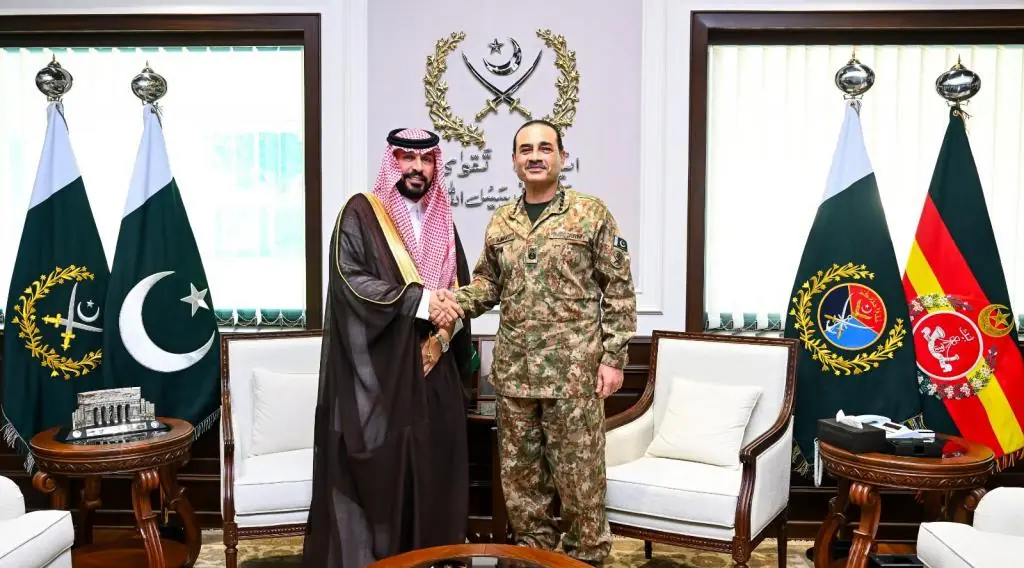
Pakistan's Chief of Defence Forces and Chief of Army Staff, Field Marshal Asim Munir, met the new Saudi envoy to Pakistan, Dr Rajeh Tami Albugamy, on Monday, and both sides expressed satisfaction with progress made under the trilateral Makkah defence agreement, according to the military's media wing. The Inter-Services Public Relations directorate, known as ISPR, said the ambassador called on Munir at General Headquarters (GHQ) in Rawalpindi, where matters of mutual interest and regional security dynamics were discussed. The envoy had assumed his diplomatic responsibilities in Islamabad the previous Thursday.
The meeting was described as a courtesy call, but it carries political weight because of the agreement under discussion and the security environment in which it took place. The Makkah defence pact, signed on August 7, links Pakistan, Saudi Arabia and Turkiye in a framework meant to deter aggression against any of them. The military's account suggests both governments want to show that the arrangement is moving beyond the formal signing stage and into day-to-day cooperation.
What the Military Statement Said
According to ISPR, both dignitaries "expressed satisfaction over the progress made under the framework of the Makkah Joint Defence Agreement and underscored the importance of strengthening defence collaboration, institutional linkages and strategic coordination." These phrases are broad. The statement did not give details of specific joint exercises, deployments, equipment transfers, command arrangements or timelines, so the public record of what has actually been carried out remains limited to the general language of the release.
Munir congratulated Albugamy on his appointment and said he was confident the envoy's tenure would further strengthen the longstanding fraternal ties between Islamabad and Riyadh. According to the statement, those ties are "rooted in shared faith, mutual trust and strategic partnership." Religious and strategic language of this kind is common in official exchanges between Pakistan and Saudi Arabia, and it reflects the long-standing closeness of the two countries, which have shared close diplomatic, economic and security links for decades.
The statement also said that matters of mutual interest and regional security dynamics were discussed. It did not say which regional developments were raised, and it did not name the specific threat that was central to the discussions, although the wider context of recent attacks on Saudi Arabia is clear from other parts of the reporting.
The Makkah Pact Explained
The Makkah arrangement is a defence pact, which means its members commit to support one another in security matters. Its stated purpose is collective deterrence. Deterrence is a long-established idea in military strategy: a state discourages an attack by making the expected costs and consequences too high for the attacker. A collective version works by making clear that an assault on one member will be treated as an assault on all of them. In principle, this raises the risk for any state that considers attacking a member, because it may face several militaries at once rather than one.
Islamabad and Riyadh have signed two defence pacts aimed at this kind of deterrence. The first is a Strategic Mutual Defence Agreement between Pakistan and Saudi Arabia. The second is the Makkah Joint Defence Alliance, which also includes Turkiye. The two arrangements are separate instruments, but both are designed to strengthen security cooperation among the countries that sign them.
Earlier this month, Pakistan, Saudi Arabia and Turkiye held an emergency meeting under the Makkah alliance. According to the reporting, the three countries agreed to deploy military forces and capabilities rapidly into the kingdom. Rapid deployment is a significant step for any defence arrangement, because it moves a pact from political commitment toward physical readiness. Such a decision is usually taken only when members judge that a security risk is immediate enough to justify moving troops and equipment in advance. The reporting does not state how many personnel or what kinds of equipment would be involved, and the military statement did not describe any deployment in detail.
Houthi Attacks and the Regional Backdrop
The meeting took place against the backdrop of Houthi attacks on Saudi Arabia. The Houthis, a movement formally known as Ansar Allah, are an armed group that controls much of northern Yemen, including the capital, Sanaa. Yemen has been in conflict for more than a decade, and Saudi Arabia led a military coalition in support of Yemen's internationally recognised government from 2015. Over the course of that conflict, the Houthis have repeatedly fired missiles and drones toward Saudi territory, and attacks on Saudi targets have been a recurring source of regional tension.
The reporting describes a recent escalation in these attacks. The statement from ISPR did not name a threat directly, but the timing of the emergency Makkah meeting and the political statements that followed make clear that the Houthi campaign was central to the concern in Islamabad and Riyadh.
In an interview aired on Sunday, the military's spokesman said Pakistan was providing "whatever support is needed" to defend Saudi Arabia amid attacks by the Houthi rebels. This is the clearest public signal in the reporting that Pakistan sees the Houthi campaign as a matter in which it may take practical steps. The spokesman's remarks did not specify what form that support would take, whether it would involve personnel, equipment, intelligence sharing or other forms of help.
Pakistan's Political Message
The envoy's engagements extended beyond the military. Last week, Albugamy met Prime Minister Shehbaz Sharif and Deputy Prime Minister and Foreign Minister Ishaq Dar. According to the reporting, Sharif reaffirmed Pakistan's support for Saudi Arabia in safeguarding its "sovereignty, security and territorial integrity" amid the recent escalation in Houthi attacks. Dar underscored the longstanding fraternal and strategic ties between the two countries and reaffirmed their "shared commitment to further strengthen bilateral cooperation for mutual progress and prosperity."
Taken together, these meetings show a coordinated message from Pakistan's civilian leadership and its military leadership. In Pakistan's system of government, the elected prime minister and foreign minister lead diplomacy and foreign policy, while the armed forces play a central role in defence matters, particularly in relations with partners that have formal military arrangements. The fact that the new envoy met both sets of leaders within days of arriving suggests that Islamabad wants to present a unified position on Riyadh's security concerns, rather than leaving the defence and political messages to diverge.
Why It Matters for Readers
For readers outside diplomatic and military circles, the story matters for several reasons. It shows how defence agreements between states can shape regional security, including the chance that countries not directly involved in a conflict may be drawn into it through a formal alliance. It also indicates that Pakistan has made the security of Saudi Arabia a significant foreign policy commitment at a time of continuing attacks in the region.
The broader setting also matters. Saudi Arabia is a major energy producer, and the Red Sea and Gulf region are key routes for global shipping and energy supplies. Attacks that threaten Saudi territory or the surrounding waters can therefore affect oil markets, shipping costs and the wider economy, even for people far from the Middle East. Analysts generally read deterrence arrangements of this kind as attempts to prevent a wider war rather than as preparations for immediate combat. Even so, any deployment of forces carries a risk of escalation, and the terms of such pacts tend to attract close scrutiny for that reason.
For Pakistan, the relationship with Saudi Arabia has long been a central element of foreign policy, involving security, economic ties and the employment of Pakistani workers in the kingdom. Any expansion of defence cooperation therefore has domestic as well as diplomatic implications, which is why official statements about the pact draw attention in Islamabad.
What to Watch Next
Several questions remain open. The statement did not give details of the forces or capabilities that might be deployed, nor a timetable for any deployment. Observers will watch whether the "institutional linkages" that both sides praised turn into concrete steps, such as joint exercises, shared planning structures or formal command arrangements. Those developments would show whether the pact is being put into operational form.
Analysts will also watch how the Houthi movement responds. Future attacks on Saudi Arabia would test the credibility of the collective deterrence the pact is designed to provide. A sustained campaign could push the members toward more visible action, while a reduction in attacks could lower the immediate pressure on the alliance.
Finally, observers will look at whether Turkiye's role in the Makkah alliance becomes more visible in the coming weeks, and whether the Pakistani military's offer of "whatever support is needed" is followed by specific measures that the public can assess. For now, the meeting in Rawalpindi offers an official account of shared commitment, but the practical shape of that commitment has not yet been made public.
Questions and answers
What is the Makkah defence pact?
The Makkah Joint Defence Alliance is a defence arrangement that includes Pakistan, Saudi Arabia and Turkiye. It was signed on August 7 and aims to strengthen collective deterrence by treating an attack on one signatory as an attack on all.
Who did Asim Munir meet on Monday?
Field Marshal Asim Munir, Chief of Defence Forces and Chief of Army Staff, met Saudi envoy Dr Rajeh Tami Albugamy at General Headquarters in Rawalpindi, according to ISPR.
Why is Pakistan's military involved with Saudi Arabia now?
The meeting came amid Houthi attacks on Saudi Arabia. In an interview aired on Sunday, the military's spokesman said Pakistan was providing whatever support is needed to defend the kingdom.
Topics: Asim Munir, Rajeh Tami Albugamy, Makkah Joint Defence Alliance, Pakistan Saudi Arabia relations, Houthi attacks, ISPR, Turkiye
Sources: Dawn
https://axynewsglobal.com/article/pakistan-s-army-chief-munir-meets-new-saudi-envoy-on-makkah-pact