
Navy Flight Nurses Who Flew Wounded Marines Out of Iwo Jima
Author Leah Garrett says 12 women flew 125 flights, evacuated 2,393 men and kept working at Okinawa
By AXY Defense Desk ·
Key points
- Twelve Navy flight nurses, including Jane Kendeigh, began evacuating wounded Marines from Iwo Jima on March 6, 1945.
- The 12 women evacuated 2,393 men on 125 flights, more than 13% of everyone evacuated from the island.
- The nurses had six weeks of training and worked in frigid, unpressurised aircraft under constant enemy assault.
- The Navy chose its nurses from hundreds of applications, and the top 24 trained at Alameda, California.
- Their work continued at Okinawa, the final island battle of the Pacific war.
- Author Leah Garrett drew on military archives and family records to write The Flight Nurses’ War.
In February 1945, U.S. Marines crawled, ran and slipped toward entrenched Japanese defenders on Iwo Jima, a volcanic island little more than four miles long. The ground under them was black volcanic sand that shifted and gave way with every step. Among the problems facing Navy and Marine planners was a question that had no easy answer: how to get the wounded off the island alive.
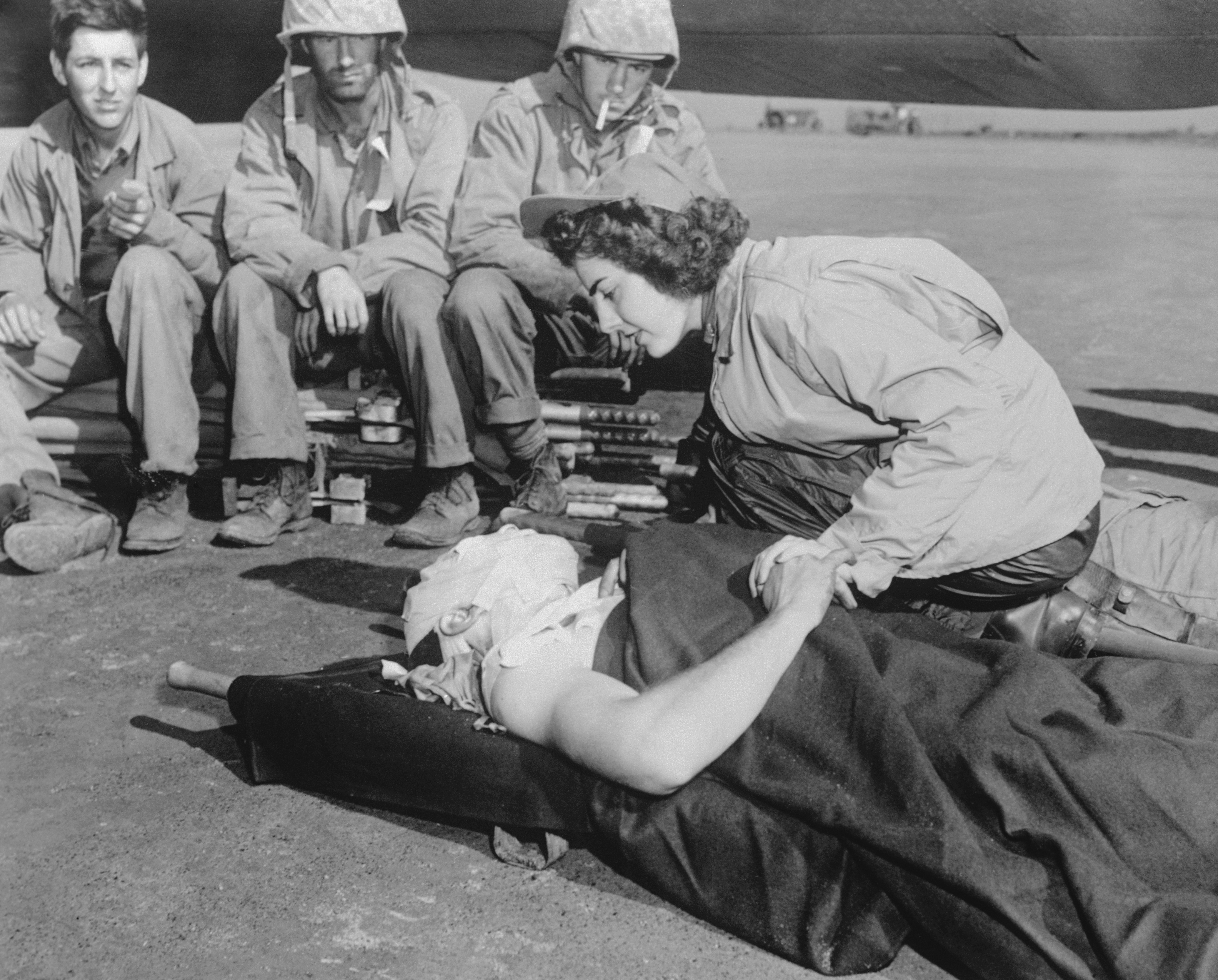
On March 6, 1945, the Navy found its solution in Jane Kendeigh and 11 fellow flight nurses. For the first time in the war, the Navy began deploying combat nurses to an active battlefield. Their work was dangerous and unfamiliar, and it changed how wounded men were moved out of a battle zone. Author Leah Garrett has now written the full story of these women, which she says had rarely been told in detail.
Their role is easy to overlook. Iwo Jima is remembered for the fighting on the beaches, the brutal conditions and the flag raising on Mount Suribachi. Few people picture the women who flew out of the battle zone with the wounded. Garrett’s book, The Flight Nurses’ War: The American Women Who Saved Thousands of Lives at Iwo Jima and Okinawa, is an attempt to fix that gap.
Why Iwo Jima Made Evacuation So Hard
The terrain was the first problem. Garrett said field hospitals could not be set up on Iwo Jima because the landscape left everything exposed. A field hospital is a medical facility set up close to the fighting, usually to stabilise wounded men before they are moved further back. Without ground that offered shelter, the medical teams had nowhere safe to work.
That left the air as the most realistic route off the island. A plane could carry men away from the fighting in a matter of hours, but only if someone on board could decide who needed help first and keep them alive during the flight. That is the job triage describes. Triage means sorting patients by how urgently they need care, so that the most seriously hurt are treated first.
The aircraft they flew in made the job harder. Source material describes the nurses working in frigid, unpressurised aircraft. An unpressurised aircraft is not sealed to hold a steady cabin air pressure at altitude, so the cabin was cold and the air was thin for the men and the crew. Nurses had to treat wounded patients in these conditions while the planes were under constant enemy assault.
Why the Navy Recruited Women for Combat Flights
The idea of women flying as nurses in a combat zone was not the Navy’s starting point. Garrett said that every one of the flight nurses had joined the military after the attack on Pearl Harbor in December 1941. For many of them, that attack was the moment they decided they needed to serve.
Garrett described one of those women, Mary O’Connor, who went to Washington and pushed for a flight nurses program. The reason was a gap in service. In Garrett’s account, the Army already had women nurses in combat positions, but the Navy did not. Creating a Navy flight nurses program meant changing that.
The need grew as the Pacific campaign turned harder than expected. Garrett said the last two battles in the Pacific were far more horrific than anyone in the Navy had expected, particularly Iwo Jima. Japanese forces also targeted medical personnel. Over time, the medical corps suffered heavy losses, a process military planners call attrition. Attrition is the steady loss of people through death, injury and capture. By the time the Navy turned to flight nurses, there were not enough medical staff left to care for the men on the island.
The decision also carried real risks for the women themselves. Garrett said no one knew what could go wrong. She listed the questions that were raised at the time: what if the nurses were killed, captured or used for propaganda? The Navy had never placed women in combat positions under direct fire. Garrett said that much to everyone’s surprise, probably including some of the women, they were highly effective.
Choosing 24 Nurses From Hundreds of Applicants
The selection process started inside Navy hospitals across the country. According to Garrett, supervisors reached out to the best one or two nurses in each group and asked whether they would be interested in overseas service. Nobody knew exactly what that assignment would involve. These women said yes anyway.
O’Connor received hundreds of applications. She chose the top 24, whom Garrett described as smart, very capable and very brave. Those 24 women were sent to Alameda, California, for six weeks of intense training. That was the entire preparation most of them had before they faced combat conditions.
The strongest of the group were then flown to Guam, where they were to receive their assignments. Guam was a staging point in the Pacific, and it was from there that the women moved toward the battles ahead. Six weeks of training was short for a job this demanding, and the women were still learning as they worked. Their willingness to take the posting on those terms is one of the central points in Garrett’s account.
Twelve Women, 125 Flights and 2,393 Men
The scale of the work at Iwo Jima is what gives the story its weight. According to the source material, the 12 women evacuated 2,393 men on 125 flights. That was more than 13% of everyone evacuated from Iwo Jima. Each flight was a small part of a larger effort, but for the men on board, each one could decide whether they reached surgeons in time.
The Navy’s use of women in this role also marked a change in how the service thought about its medical teams in a front-line setting. The nurses were not behind the lines. They were in the aircraft as the enemy fired on the island and the planes flew in and out. The source describes the men who survived this work as calling them “mom,” a sign of how close the bond was between the nurses and the wounded.
That closeness mattered as much as the medical skill. A wounded man on a cold, moving aircraft needed someone to steady him, tell him what was happening and treat him with care. The nurses did that job in the middle of the same battle that had wounded him.
Finding the Nurses’ Story in Family Basements and Garages
Garrett first heard rumours that there had been women at Iwo Jima while she was working on her previous book. She did not believe them at first. She said there was no way women had been on the island. Once she began looking into the claims, she found that the Navy had indeed sent 12 flight nurses who landed under fire and flew men out.
She contacted the Navy, received military clearance and worked with an archivist there. He had written a little about the nurses, but no book had ever told their full story. Garrett said part of the reason was that the women themselves did not appear to realise how remarkable their work had been. In her words, “I don’t think they realized how extraordinary it was what they had done.”
The material that did survive was in private hands. Garrett said most of it was stored in well-cared-for boxes in basements and garages. She worked with the military archivists, then travelled around the country to meet the families of the 12 nurses. She interviewed their children and went through the boxes, which contained photographs, letters and memoirs. Her book draws on that first-person material alongside the official record.
The interview process also gave Garrett a deeply personal experience. Speaking about the research, she described one of “the most moving moments of my life.” The source does not say which moment that was, so readers should take her description as her own account of how the work affected her.
From Iwo Jima to Okinawa
The nurses did not stop after Iwo Jima. They continued their lifesaving work at Okinawa, which was the largest Allied amphibious landing in the Pacific theatre and the final island battle of the Pacific war. An amphibious landing is an assault in which troops come ashore from ships and landing craft, and it is one of the most difficult kinds of military operation because the attackers are exposed as they arrive.
For the wounded, the speed of evacuation at Okinawa mattered in the same way it had at Iwo Jima. A quick flight out could mean surgery in time. A longer wait on the beach or in a crowded aid station could mean the difference between living and dying. The nurses’ experience at Iwo Jima gave them a basis for that work at Okinawa, and Garrett’s book follows them through both campaigns.
The story also raises questions about how this history is remembered. Military records, family archives and books like Garrett’s are the main ways the work of these women can be preserved. If more families come forward with letters and photographs, historians and military educators may be able to fill in parts of the record that have so far been missing. That is one reason Garrett’s research matters beyond a single book.
For readers, the lesson is practical as well as historical. The Navy faced a medical problem that the terrain made almost impossible to solve on the ground. It answered by sending women into the air under fire, with six weeks of training and a clear sense of the risks. The story of Jane Kendeigh and the 11 women who flew with her is now part of the record of how the Pacific war was fought, and how it was survived.
Questions and answers
Who were the flight nurses who served at Iwo Jima?
The Navy sent Jane Kendeigh and 11 fellow flight nurses to Iwo Jima beginning March 6, 1945. They were selected from Navy hospitals and trained for six weeks at Alameda, California.
How many Marines did the flight nurses evacuate?
According to the source material, the 12 women evacuated 2,393 men on 125 flights. That was more than 13% of everyone evacuated from Iwo Jima.
Why did the Navy use flight nurses at Iwo Jima?
Field hospitals could not be built on the exposed island, and medical staff had suffered heavy losses. The Navy needed a fast way to move the wounded off Iwo Jima, and the nurses were trained to triage them in the air.
Where did the flight nurses go after Iwo Jima?
The nurses continued their evacuation work at Okinawa, the largest Allied amphibious landing in the Pacific theatre and the final island battle of the Pacific war.
Topics: Iwo Jima, Navy flight nurses, Jane Kendeigh, Leah Garrett, Okinawa, World War II, Pacific War, Military medicine
Sources: Military Times
https://axynewsglobal.com/article/navy-flight-nurses-who-flew-wounded-marines-out-of-iwo-jima