
Marine Corps Creates First Medium Missile Battalion at Camp Lejeune
The 1st Battalion, 10th Marine Regiment will field the NMESIS anti-ship missile system under Force Design 2030
By AXY Defense Desk ·
Key points
- The 1st Battalion, 10th Marine Regiment at Camp Lejeune, North Carolina, is now the Marine Corps’ first medium missile battalion.
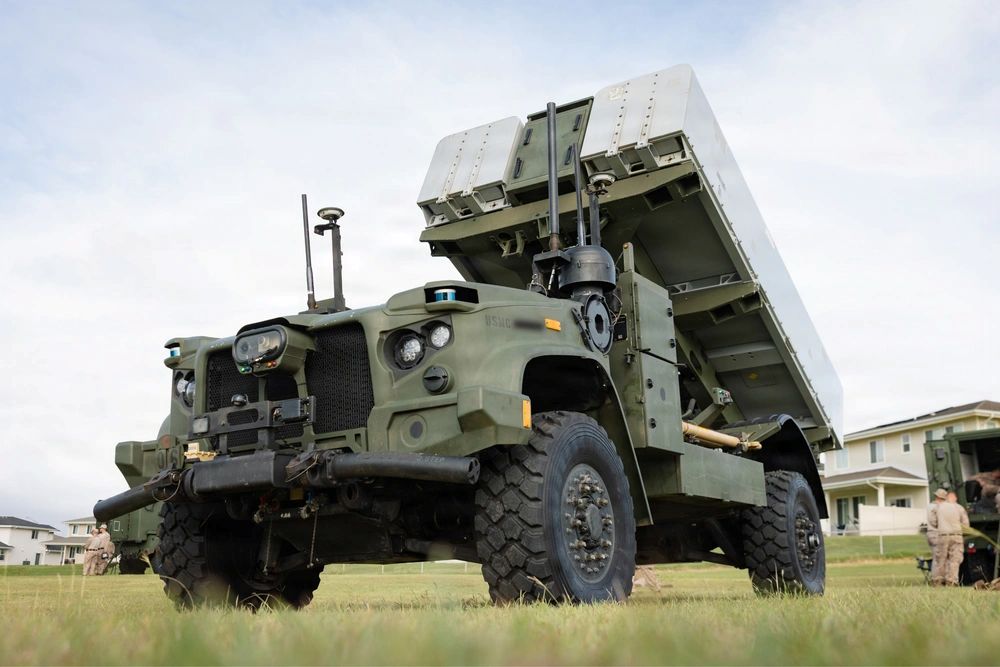
- The unit will be equipped with NMESIS, an unmanned JLTV carrying two Naval Strike Missiles, as part of Force Design 2030.
- NMESIS was tested in 2021 off Hawaii with an effective range of 130 nautical miles and has since been introduced to two Marine Littoral Regiments.
- The 10th Marines will keep its lightweight howitzer capabilities, with NMESIS serving as a complement.
The U.S. Marine Corps has redesignated an artillery battalion at Camp Lejeune, North Carolina, as the service’s first-ever medium missile battalion, a change that will equip the unit with the Navy-Marine Expeditionary Ship Interdiction System, or NMESIS, according to a recent Marine Corps release reported by Military Times on October 20, 2026. The unit, the 1st Battalion, 10th Marine Regiment, will field the system as part of the service’s ongoing Force Design 2030 modernization plan.
The change matters because it marks a shift in how the Marine Corps expects to fight. Instead of relying only on traditional artillery, the battalion will add a weapon designed to strike ships at sea from land. Military planners see that capability as central to the service’s evolving role in a conflict that could involve control of sea lanes and island chains in the Pacific.
What the Redesignation Means
Lt. Col. Joseph Mozzi, the battalion’s commanding officer, called making the service NMESIS-capable “a crucial step to facilitate the maritime component commanders to fight for sea control.” He described the system as “the Marine Corps’ emerging ground-based anti-ship missile capability,” and said it “will also be a ground-based long-range precision fires platform,” according to the announcement.
For readers less familiar with military terms, an anti-ship missile is a weapon designed to hit warships and other vessels. Precision fires refers to strikes, typically from artillery or missiles, that are aimed at specific targets at long distances. Sea control is the ability to use a body of water for one’s own military and commercial purposes while denying an adversary the same use. Commanders of naval and joint forces depend on it to move troops, supplies and ships safely, so a land-based unit that can threaten enemy vessels could help them hold contested waters.
Analysts who follow the Marine Corps generally expect that a land-based missile unit could make it costlier for an opponent to operate ships near coastlines and islands. That assessment is analysis rather than a reported outcome of this redesignation, and the source material does not describe how many launchers or personnel the battalion will field.
How the NMESIS System Works
According to the service, NMESIS consists of an unmanned Joint Light Tactical Vehicle, or JLTV, with two Naval Strike Missiles mounted on its chassis. The JLTV is a light, wheeled military vehicle developed to replace older tactical trucks across the U.S. armed forces. The Naval Strike Missile is an anti-ship missile originally developed in Norway and produced by the Norwegian company Kongsberg, and it is designed to be launched from land, sea and air platforms.
Putting the missiles on a vehicle gives the unit mobility. Marines can move the launchers to different positions along a coast or island, which can make it harder for an adversary to locate and target them. The unmanned configuration means the vehicle itself does not need a crew inside it during operations, a feature that military planners often cite as a way to reduce the risk to personnel near the front line. The source material does not provide further technical specifications, and readers should treat any additional performance details as outside this report.
Testing and Fielding History
The service said Marines successfully tested the weapon system during a 2021 exercise off the coast of Hawaii, where it had an effective range of 130 nautical miles. A nautical mile is slightly longer than a standard statute mile, equal to about 1.15 miles. The test is an important early step because it showed the missile could reach distant targets from a land-based launcher.
The Marine Corps then introduced the system to two other units. It went to the 3rd Marine Littoral Regiment in 2024 and to the 12th Marine Littoral Regiment in 2025. Marine Littoral Regiments are units organized for operations in coastal and island areas, where small, dispersed teams can operate and strike targets over long distances. The pattern suggests the service has been moving NMESIS from testing into operational units over several years, and the redesignation of the 1st Battalion, 10th Marines continues that process.
Force Design 2030 and the Broader Plan
Force Design 2030 is the Marine Corps’ long-term modernization plan, launched in 2020 by then-Commandant Gen. David Berger. The plan calls for reshaping the service around smaller, more mobile units that can operate in the Pacific and support naval operations, rather than focusing mainly on large land campaigns. The NMESIS redesignation is one of the most concrete changes so far to be described publicly under that plan, although the source material does not give a full timeline for further changes.
The approach reflects concern about long-range threats in the Indo-Pacific region. Military planners have argued that future conflicts could involve longer distances and more precise weapons, which would make dispersed, mobile forces harder to target than large, fixed bases. Analysts generally see land-based anti-ship missiles as one way for the Marine Corps to contribute to that kind of defense.
Deployment Near Taiwan and Exercise Keen Sword
Earlier in October, the Marine Corps deployed NMESIS along with the Marine Air Defense Integrated System, or MADIS, to Japan’s southwesternmost island for exercise Keen Sword. The island lies about 69 miles from Taiwan, according to the source. MADIS is a system designed to detect and counter air threats, so deploying it alongside NMESIS suggests the exercise tested how the two systems could work together.
The location is significant because Taiwan and the surrounding waters are a focus of military attention in the region. Keen Sword is an exercise involving the United States and Japan, and it is designed to improve their ability to operate together. Any deployment close to Taiwan is closely watched by governments in the region, and analysts often describe such moves as signals of deterrence, meaning efforts to discourage an adversary from taking aggressive action. The source material does not describe the exercise’s results, and this report does not claim any specific outcome.
Artillery Remains Part of the Regiment
The 1st Battalion is now a medium missile battalion, but the 10th Marines are not giving up artillery. Col. William Soucie, commanding officer of the 10th Regiment, 2nd Marines Division, said the regiment will keep its lightweight howitzer capabilities, with NMESIS serving as a complement to them. Lightweight howitzers are artillery pieces that can be moved more easily than heavier models, which helps them keep pace with fast-moving units.
Soucie also emphasized the people behind the equipment. “While the transition of the weapons platform is interesting, what makes the story compelling is that the Marines and Sailors in that formation are not changing,” he said. “They are just as good as they have always been, and they will make the platform successful and whatever mission they are assigned successful because they are phenomenal.” His comments point to a common theme in modernization efforts: new equipment depends on trained personnel to be effective.
What to Watch Next
The source material does not give a schedule for when the 1st Battalion will reach full operational capability with NMESIS, nor does it say how the unit will train with the Navy or other joint forces. Those details will show how quickly the redesignation turns into combat-ready capability.
Several developments could indicate the direction of the program. Observers will look for announcements of additional units receiving NMESIS, results from future exercises, and any changes to how the Marine Corps integrates land-based missiles with naval operations. Each of these would help show whether the service is moving from initial fielding toward a broader force structure. Until those details are released, the current announcement is best understood as a significant organizational step whose full effects remain to be seen.
Questions and answers
What is the Marine Corps’ first medium missile battalion?
The 1st Battalion, 10th Marine Regiment at Camp Lejeune, North Carolina, was redesignated as the service’s first-ever medium missile battalion. It will be equipped with the Navy-Marine Expeditionary Ship Interdiction System, or NMESIS.
What is NMESIS?
NMESIS consists of an unmanned Joint Light Tactical Vehicle with two Naval Strike Missiles mounted on its chassis. The Marine Corps describes it as its emerging ground-based anti-ship missile capability that will also serve as a long-range precision fires platform.
Why is the Marine Corps adding missiles to this battalion?
Lt. Col. Joseph Mozzi said NMESIS is a crucial step to help maritime component commanders fight for sea control. The change is part of the Force Design 2030 modernization plan.
Will the 10th Marines still use artillery?
Yes. Col. William Soucie said the regiment will retain its lightweight howitzer capabilities, with NMESIS serving as a complement to them.
Topics: Marine Corps, NMESIS, Camp Lejeune, 1st Battalion 10th Marines, Force Design 2030, Naval Strike Missile, Keen Sword, Anti-ship missiles
Sources: Military Times