
Hanwha Says Its Lasers Downed Three Drones in South Korean Army Demo
Cheongwang laser and a 30-kilowatt vehicle-mounted system took part in live fire at Yangpyeong, as the company pitches the technology to foreign buyers
By AXY Defense Desk ·
Key points
- Hanwha Systems says two of its laser weapons shot down all three target drones during a South Korean Army live-fire demonstration on October 14.
- The Cheongwang laser and a 30-kilowatt-class vehicle-mounted laser took part as part of a layered counter-drone display that also included electronic jamming and a K21 armored vehicle.
- Hanwha says each Cheongwang shot costs about $1.50 and that the weapon uses no ammunition, but independent verification of these claims has not been published.
- South Korea first fielded Cheongwang in December 2024 and had about five units at major government facilities as of June, according to Korea JoongAng Daily.
- Hanwha is pursuing export talks with buyers in Europe, Asia and the Middle East and plans to begin production of its 50 kW Laser Armored Vehicle by the end of 2027.
Two laser weapons developed by Hanwha Systems shot down all three target drones during a South Korean Army demonstration on October 14, according to the company, which is using the test to promote the technology to foreign buyers.
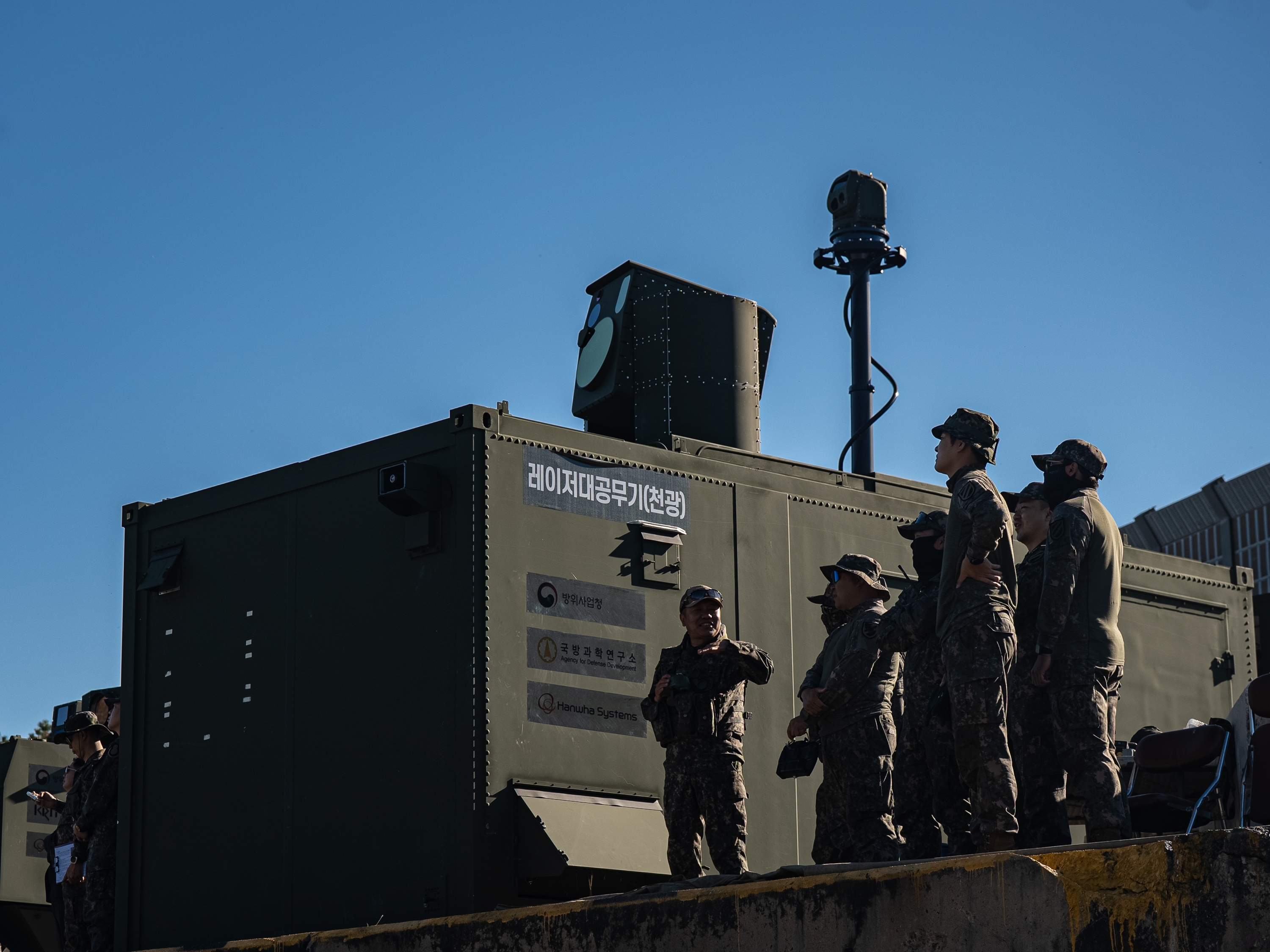
The stationary Cheongwang laser air defense weapon and a 30-kilowatt-class vehicle-mounted laser took part in the live-fire event. It was held during the Army's TIGER+ Future Warfare Integrated Combat Exercise. Hanwha said about 500 people attended, including Army Chief of Staff Gen. Kim Kyu-ha. The Korea Times reported from the exercise at a training ground in Yangpyeong, Gyeonggi Province, and quoted the moment a drone overhead was hit by the Cheongwang laser and "caught fire and fell from the sky."
What the Army demonstration showed
The demonstration was not a laser-only test. It was one part of a layered counter-drone display that also included electronic jamming, which disrupts the radio links that drones depend on, and a K21 armored vehicle firing on incoming drones. That mix matters because it reflects how militaries now expect to defeat small unmanned aircraft: no single tool is assumed to work against every threat, and different layers are meant to cover one another.
Hanwha did not say which system destroyed which drone, what kinds of drones were used, what vehicle carries the newer laser, or the effective range of either weapon. Those omissions limit what can be independently judged from the company's account. The figure of three drones shot down is the company's own statement, and the public record of the event so far comes largely from Hanwha and from press coverage of the exercise.
The October 14 event was not the first public showing. Hanwha said that on September 16, at South Korea's 2026 Defense Drone Technology Exhibition, Cheongwang downed four drones and two larger unmanned aircraft in succession. Taken together, the two events suggest the company is trying to build a record of repeated live demonstrations ahead of export talks.
How the Cheongwang laser works
Cheongwang, which means "light of the sky" in Korean, is formally known as the Laser Air Defense Weapon Block-I. Hanwha developed it under a program led by South Korea's Agency for Defense Development, the state body that oversees much of the country's weapons research. The company describes it as the world's first operationally deployed laser weapon. That claim is Hanwha's own and has not been independently assessed in the source material.
In general terms, a laser weapon directs a concentrated beam of light at a target and heats or damages its structure until it fails. Unlike guns or missiles, the system uses no physical ammunition. Hanwha says it can keep firing for as long as it has electrical power, which is a central part of the pitch: a weapon limited only by power supply behaves differently from one that runs out of rounds or interceptors.
Hanwha says each Cheongwang shot costs about $1.50. The company points to a figure South Korea's arms procurement agency gave in 2024 as consistent with that number. If accurate, the per-shot cost is far below that of many missile interceptors, which are typically built for much larger and more expensive threats. Cost comparisons of this kind depend heavily on what is counted, including power generation, maintenance, sensors and the operating crew, so the headline number should be read as a company-supplied estimate rather than a full lifetime cost.
Why counter-drone lasers are drawing attention
The appeal of laser defenses is closely tied to the rapid spread of cheap drones. Small unmanned aircraft are now used for surveillance, reconnaissance and attacks, often in large numbers. Expensive missiles can be inefficient against low-cost targets, and militaries have been searching for layered defenses that can handle swarms or repeated attempts without exhausting costly stocks.
Hanwha argues that lasers can counter cheap drones used for surveillance and strikes without depending on much more costly missile-based air defenses. Analysts generally treat this as the core logic behind the current wave of directed-energy programs. They also note that lasers have practical limits: performance can be affected by weather, dust and smoke, and the effectiveness against different drone designs, speeds and distances depends on testing that is not fully described publicly in this case. Whether a particular demonstration reflects reliable performance under combat conditions is a separate question from whether the weapon can hit a target in a controlled range.
For ordinary citizens, the stakes are less about technical specifications than about whether air defense can protect sites such as government buildings, military bases and major cities from low-flying unmanned aircraft. For governments, the question is whether such systems can be bought at a scale and price that makes them a practical part of national defense budgets.
North Korean drone incursions and the case for air defense
For South Korea, the threat is not theoretical. Drones from North Korea have repeatedly crossed into South Korean airspace. In December 2022, five North Korean drones crossed the border, with one reaching Seoul. Fighter jets, attack helicopters and warning shots failed to bring any of them down, as Defense News reported at the time. That episode exposed a gap between the ability to detect small unmanned aircraft and the ability to stop them quickly and reliably.
South Korea first fielded the Cheongwang system in December 2024. According to Korea JoongAng Daily, the country had about five units at major government facilities as of June, including the Ministry of National Defense building. The placement of these units at key government sites indicates that the system is being used to protect high-value locations rather than only serving as a trial product, although the public record does not provide full detail on operational coverage.
The 2022 incursion helps explain why South Korea has invested in counter-drone technology more broadly. Electronic jamming, guns, missiles and lasers each address different threats, and the October demonstration combined several of them. This layered approach is likely to remain central to how the country plans for drone attacks, particularly from its northern neighbor.
Hanwha's export push and the open questions
Hanwha is also developing a 50-kilowatt Laser Armored Vehicle in-house for export customers. The company displayed a model of it at the MSPO defense show in Kielce, Poland, in September. At that show, Hanwha Systems manager Hyungun Park told Defense News that the company had built a prototype and planned to begin production by the end of 2027. He said Hanwha was in talks with potential buyers in Europe, Asia and the Middle East about exporting Cheongwang.
Export interest is a significant part of the story. Defense companies often need foreign customers to justify the cost of developing and producing new systems, and demonstrations like the October 14 event are designed to show that a product works under realistic conditions. However, export deals typically depend on government approvals, budget decisions, technology-transfer rules and the buyer's own security priorities, none of which are described as settled in the source material.
The company's plans also depend on South Korea's own spending. The country's 2027 defense budget proposal includes funding to begin research on a mobile Block-II version of Cheongwang, according to UPI. A mobile version would be a logical step for a military that needs to protect units on the move, not only fixed sites. Whether that research funding is approved, and how quickly it translates into a fielded system, will be important signals for both domestic and foreign observers.
What to watch next
Several questions remain open. The most immediate is whether Hanwha releases more detailed results from the October 14 demonstration, including which systems destroyed which drones, what types of drones were involved and the range of the weapons. Independent confirmation of the three-drone result, or further details from the Army, would help separate what has been shown from what has been claimed.
Analysts will also watch whether the Block-II research funding proposed in the 2027 budget is approved, and whether the 50-kilowatt vehicle-mounted laser moves from prototype toward production as planned by the end of 2027. Any confirmed export agreement with a buyer in Europe, Asia or the Middle East would be a major test of whether the technology can move beyond South Korean government use.
Finally, the wider question is whether laser weapons can become a dependable part of air defense rather than a promising addition to a layered system. The answer will depend on performance in varied conditions, transparent testing and the economics of deployment at scale. For now, the October demonstration shows that the technology is being pushed into public view, but the detailed evidence needed for a full assessment has not yet been released.
Topics: Hanwha Systems, Cheongwang laser, South Korean Army, Laser Air Defense Weapon, Counter-drone defense, Agency for Defense Development, North Korean drones, Yangpyeong
Sources: Defense News