
French Newspaper Blasts Macron as Riots Spread Across France
Le Figaro columnist accuses France's leadership of failure after looting, arson and clashes with police
By AXY War & Crime Desk ·
Key points
- Le Figaro columnist Vincent Trémolet de Villers blamed France’s political leadership and President Emmanuel Macron for nationwide riots, calling Macron’s reprimands of police “an indelible stain.”
- Authorities estimated about 550,000 people joined Saturday’s protests, while organizers said 800,000, according to the Associated Press; at least 2,400 were arrested.
- More than 500 police officers, gendarmes and firefighters were injured, according to Interior Minister Laurent Nuñez as cited by the Associated Press.
- Macron condemned the violence, said those who looted must pay for their crimes, and ordered increased security around public buildings and businesses.
- Macron faces criticism over attending a Celine Dion concert with his wife on the eve of the demonstrations, and his office had not responded to requests for comment.
A prominent French newspaper has delivered a harsh verdict on the country's leadership after nationwide protests turned into riots, looting and arson. In a column published Sunday afternoon local time, Vincent Trémolet de Villers wrote for the conservative newspaper Le Figaro that years of political failure had helped create the unrest, and he singled out President Emmanuel Macron, calling the president's past rebukes of police “an indelible stain.” The column, cited by Fox News in a translation, comes as France counts the cost of a weekend of violence that authorities say left hundreds of businesses looted and hundreds of security personnel injured.
What the Column Argued
Trémolet de Villers’ piece goes well beyond a description of the weekend’s events. It makes a broader case that France’s justice system, immigration policy and security arrangements have failed ordinary citizens. He wrote of “a judiciary that is lenient toward criminals but unrelenting toward decent citizens,” and he accused far-left groups of violence with “impunity,” using the phrase “far-left militias” to describe those he held responsible for destroying property and setting fires. He also criticized what he called “uncontrolled immigration,” arguing that some immigrants rebel against the country that took them in. These are opinions presented in a signed column, not findings of an official investigation.
The author’s most pointed target was Macron himself. He pointed to the president’s earlier reprimands directed at police, whom Macron had reportedly described as insufficiently “empathetic.” According to the column, those comments came at a time when officers were under attack from projectiles including bolts, cobblestones and mortar fireworks. The column also argued that the unrest showed how fragile social order can be, writing that if “the far-left, criminals, and looters can turn France upside down in a matter of hours,” it is primarily because a “technocratic monarchy” has “methodically dismantled” the moral, security, cultural and economic safeguards that hold a society together. A technocratic monarchy is a phrase critics use to describe a system in which decisions are made by expert elites with little accountability to voters.
A Weekend of Violence Across France
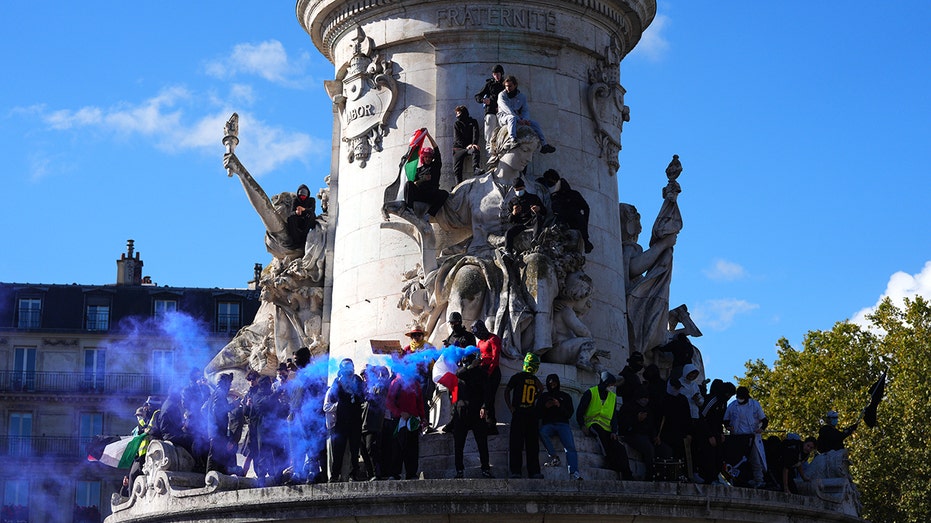
The column followed a day of violence in which masked groups clashed with police, looted businesses, set fires and attacked public buildings, according to the Associated Press. Arson, the deliberate setting of fires, was among the main forms of damage. Unrest continued on Sunday in Paris, where police used tear gas as tensions flared around Place de la République, one of the city’s best-known public squares and a common gathering point for demonstrations.
The scale of the protests was significant. Authorities estimated that roughly 550,000 people took part in Saturday’s demonstrations, while organizers put turnout at 800,000, according to the Associated Press. Most demonstrators were not involved in the violence, but the clashes and property damage overshadowed the marches. At least 2,400 people were arrested nationwide, including 855 in the Paris region. More than 500 police officers, gendarmes and firefighters were injured, the Associated Press reported, citing Interior Minister Laurent Nuñez. Gendarmes are members of France’s national police force with a military status, and they are often deployed to maintain public order during large demonstrations.
Macron’s Response
Macron addressed the nation on Sunday evening, condemning the violence and promising accountability. “Nothing will excuse their actions. We all tonight feel angry. We feel shame as well,” he said, according to a translation of his televised remarks. “There needs to be a response. Those people who looted need to pay for their crimes,” he added.
The president also addressed the underlying frustrations behind the protests. He said that young people were expressing “great anguish and concern about the future,” including worries about their careers and their place in society. “I hear what they are saying, for the past ten years I’ve been fighting for them, so we need to pay heed to what they are saying,” Macron said. He also said he had ordered officials to increase security around public buildings and businesses, and that protests could be restricted in some areas. Those measures suggest the government is trying to balance two goals: restoring order in the short term and responding to the grievances that brought people onto the streets.
The Concert Controversy
Macron’s response has been overshadowed for some critics by his own schedule. He faces scrutiny over his decision to attend a Celine Dion concert with his wife, Brigitte, on Friday night, the eve of the nationwide demonstrations. Fox News reported that the criticism arrived as unrest was escalating. Macron’s office and Le Figaro could not immediately be reached by Fox News Digital for comment, so it is not yet clear how the presidency will respond to the column or to the concert criticism.
Background: Why the Protests Erupted
The protests were fueled in part by anger over rising living costs, school conditions and public services, according to the Associated Press. These are longstanding issues in French politics. Macron was first elected president in 2017 and re-elected in 2022, and he is serving a five-year term that runs until 2027. Since his first election, his government has faced several large public movements over economic and social policy. The most prominent was the “yellow vest” movement that began in late 2018, which started as opposition to fuel tax increases and grew into a wider protest over living costs and perceived distance between leaders and ordinary citizens. The current protests, as described by the Associated Press, share some of the same economic concerns, although the reporting available here does not say how closely the two movements are linked.
Why the Column Matters
Le Figaro is one of France’s oldest daily newspapers and is generally regarded as conservative. Its opinion pages are a space for strongly worded commentary, and a column of this kind is an important signal of how parts of the political right and centre-right view the government. Trémolet de Villers’ words are significant less because they are news in themselves and more because they show how the riots are being used in a wider argument about crime, immigration and the state’s authority.
The column also matters because it reflects a debate that extends beyond one newspaper. Supporters of stronger policing argue that violent protest must be punished more severely. Critics of the government argue that the root causes of anger, including economic insecurity and young people’s concerns about the future, must be addressed as well. Macron’s own remarks suggest that the government accepts both points, though the column makes clear that many commentators think the government has not done enough on either front.
What to Watch Next
Several questions will shape the coming days and weeks. The first is the judicial process: at least 2,400 people were arrested, and the outcome of those cases will show how the justice system handles mass arrests and whether prosecutions are swift. Analysts often watch such cases closely, because critics of the justice system will judge it by its response.
A second question is how far the security measures announced by Macron will go, and whether any restrictions on protests will be challenged in court or in parliament. Restrictions on demonstrations can prompt debate over civil liberties, and that debate could become part of the political argument.
Third, the government will need to show how it is responding to the economic concerns that the Associated Press linked to the protests. Macron has said he hears the young people who are protesting. Whether specific policies follow will be a test of that promise.
Finally, the column and the wider debate are likely to influence the political landscape ahead of the next presidential election in 2027. Commentators may see the riots and the column as a preview of how the campaign could be framed around public order, immigration and the performance of the current government. These are analytical expectations, not confirmed outcomes, and the coming weeks will show which of them take hold.
Questions and answers
Why did Le Figaro criticize Emmanuel Macron?
In a column published Sunday, Vincent Trémolet de Villers blamed years of political failure for the unrest and criticized Macron’s earlier reprimands of police, calling them “an indelible stain.” The column also criticized the justice system, far-left violence and immigration policy.
How many people were arrested in the French riots?
At least 2,400 people were arrested nationwide, including 855 in the Paris region, according to the Associated Press. More than 500 police officers, gendarmes and firefighters were reported injured.
What did Macron say about the riots?
Macron condemned the violence, saying “nothing will excuse their actions,” and said those who looted “need to pay for their crimes.” He also said he heard young people’s concerns about their future and ordered increased security around public buildings and businesses.
What sparked the French protests?
The protests were fueled in part by anger over rising living costs, school conditions and public services, according to the Associated Press. They turned violent on Saturday, with masked groups clashing with police and looting businesses.
Topics: Emmanuel Macron, France riots, Le Figaro, Vincent Trémolet de Villers, French protests, Laurent Nuñez, Paris
Sources: Fox News
https://axynewsglobal.com/article/french-newspaper-blasts-macron-as-riots-spread-across-france