
Four Canadian Service Members Killed, Dozens Hurt in Alberta Base Fire
Prime Minister Mark Carney says wind-driven flames spread from Canadian Forces Base Wainwright into rural Alberta as hospitals activated mass-casualty plans
By AXY War & Crime Desk ·
Key points
- Four Canadian military service members were killed and dozens seriously injured in a fire during training at Canadian Forces Base Wainwright in Alberta on Saturday, Prime Minister Mark Carney said Sunday.
- Carney called it one of the country's worst peacetime military tragedies on domestic soil and ordered flags flown at half-staff on federal buildings.
- Canadian military officials said there were no indications of terrorism, but the cause remains under investigation, with the RCMP involved.
- Gusts of up to 62 mph carried the fire beyond the base; by late Saturday it was being held, and no evacuation order had been issued.
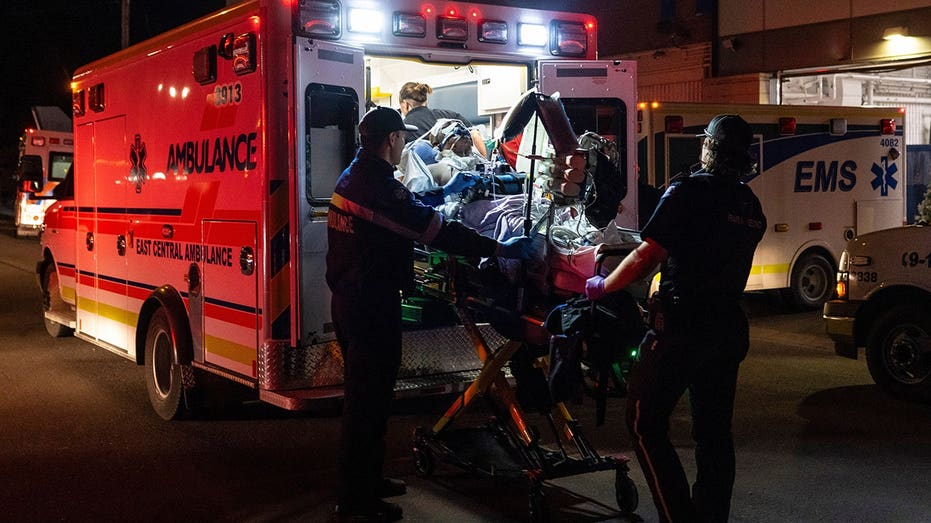
- Injured personnel are being treated in Wainwright, Edmonton, Red Deer and Calgary, and several Alberta hospitals activated Code Orange.
Four Canadian military service members were killed and dozens more seriously injured after a fire broke out during training at Canadian Forces Base Wainwright in Alberta on Saturday, Prime Minister Mark Carney announced on Sunday. In a televised address, Carney said the families of the four people killed had been notified and that the situation was still changing. He described the incident as one of the country's worst peacetime military tragedies on domestic soil.
Canadian military officials said there were no indications of terrorism, but the cause of the fire remains under investigation. The Royal Canadian Mounted Police, Canada's national police force, is involved in the inquiry. Canadian Defence Minister David McGuinty initially confirmed the deaths and injuries but did not release a casualty count. The account in this report draws on the prime minister's address, McGuinty's remarks to reporters, and reporting by Fox News Digital and The Associated Press.
How the Fire Unfolded
According to the RCMP, officers responded to reports of a fire in a training area at the base shortly after 4 p.m. local time on Saturday. Fierce winds drove the flames past the boundaries of the installation and into surrounding rural land. Firefighters battled the blaze in gusts reaching up to 62 mph, or about 100 km/h. By late Saturday, local officials said the fire was being held and that property and critical infrastructure had been protected. No evacuation order had been issued for nearby residents.
Wind is the element that most changes how a fire behaves. Strong gusts can push flames forward quickly, lift burning debris into the air, and carry embers well ahead of the main fire line, starting new blazes that firefighters must then contain. In open rural country, where grass, scrub and farmland offer few natural barriers, a fire can move faster than crews can reposition. The source material reports that this is what happened here, with flames leaving the base and spreading into the countryside before they were brought under control.
The timing of the response also matters. Fire crews fought the flames through the night, and Carney publicly praised those emergency workers. Containing a fire that has crossed from a restricted military area into civilian land usually requires coordination between military firefighters, civilian fire services and police, because each agency has its own responsibilities for safety, access and evacuation decisions.
Who Was Affected
Carney said those affected included reservists and soldiers from Princess Patricia's Canadian Light Infantry, one of Canada's oldest military regiments. The regiment was raised in 1914 and has a long record of service in the country's major conflicts. Its members are regular soldiers, while reservists are part-time members of the Canadian Armed Forces who train on evenings and weekends and join full-time exercises when called. Their presence in a field training exercise shows how reserve and regular soldiers often train side by side.
Personnel had travelled from bases across the country to take part in training exercises at Wainwright. That detail matters beyond Alberta. A single large exercise can bring units from several provinces into the same location, so families, colleagues and home bases across Canada may all be affected by one incident. The source material does not say how many personnel were present, and the exact number of injured service members remained unclear on Sunday.
The injured were being treated at hospitals in Wainwright, Edmonton, Red Deer and Calgary. Spreading patients across several cities is a common response to a mass-casualty event, because it prevents any single hospital from being overwhelmed and allows patients to be matched with the specialist care they need.
McGuinty told reporters: "I cannot recall such an incident in my short time for sure as a minister, but I cannot recall an incident like this in recent memory." He also said the RCMP was involved in investigating the incident, describing the situation as "very, very active and delicate." Those remarks suggest that officials are treating the case as a serious investigation rather than a routine accident review, while still gathering facts.
How Hospitals Responded
Several hospitals across Alberta activated a "Code Orange," an emergency designation used for mass-casualty incidents. The label signals that the number of incoming patients may exceed what a hospital can handle through normal operations. Activating it typically allows staff to be recalled, operating rooms and beds to be freed up, and supplies and specialist teams to be mobilised quickly.
Dr. Warren Thirsk, an emergency department physician at Royal Alexandra Hospital in Edmonton, told CBC News: "This number of patients would overwhelm the city of Edmonton. It is more patients than any of us want to count right now. It's a disaster." His comments give a sense of the pressure on emergency staff in the first hours after the fire, when clinicians must sort patients by urgency while the full scale of injuries is still unknown.
Fire injuries are among the most demanding cases for emergency and trauma teams. Burns can require repeated surgery, specialised wound care, pain control and long rehabilitation. Smoke can damage the airways and lungs, and breathing problems sometimes develop hours or days after exposure. For this reason, the final number of seriously injured people may not be clear for some time, and medical needs can continue long after the initial emergency response has ended.
Why the Base Matters
Canadian Forces Base Wainwright is a major training installation in east-central Alberta. The Canadian Army uses its large land areas to run field exercises that cannot easily be carried out in populated areas. These include live training that involves vehicles, weapons and large groups of troops operating over wide ground. Such exercises are designed to prepare soldiers for realistic conditions, but they also introduce hazards, including fire, that must be managed carefully.
It matters to readers because training accidents can be as deadly as combat in some cases, even though they occur in peacetime. The prime minister's description of the event as one of the country's worst peacetime military tragedies on domestic soil reflects how rare such a loss of life is within Canada's borders. It is also why the public, families and military personnel will be paying close attention to what caused the fire and whether existing safety rules were followed.
It is important not to draw conclusions about the cause before the investigation is complete. Officials have said there were no indications of terrorism, but they have not publicly identified what started the blaze. Investigations into deadly training incidents typically examine multiple factors, including the planned activity, equipment, supervision, weather conditions and decisions about whether to continue operations. Any single explanation at this stage would be speculation.
National Response and Public Mourning
Carney ordered flags to be flown at half-staff on federal buildings across the country in honour of those killed and injured. Lowering flags to half-staff is a traditional way for a government to mark national mourning. It signals that the loss is being treated as a matter for the whole country rather than only for the local community or the military.
The national response also shows that the incident is being handled at the federal level. The prime minister addressed the country directly, the defence minister spoke to reporters, and the national police were brought in to investigate. This structure is common for incidents involving military personnel, because the Canadian Armed Forces answer to the federal government, and deaths involving service members can require both military oversight and independent police work.
What to Watch Next
Several questions will shape the coming days and weeks. The most immediate are the final casualty count, the names of the four people who died once their families have been informed, and updated condition reports for the injured. The number of people hurt is still unclear, and officials have not yet released the full picture.
The cause of the blaze is the central open question. The RCMP-led investigation will be watched closely by military families, veterans and the public, and its findings will determine whether the fire was an unavoidable accident or the result of a preventable failure. Officials have said there were no signs of terrorism, but that does not answer questions about training procedures or safety decisions.
Analysts expect the Canadian Armed Forces to carry out its own internal review of safety procedures for training in windy conditions, and say such reviews can lead to changes in how exercises are scheduled, supervised and halted when weather becomes dangerous. If investigators find avoidable failures, analysts say there would likely be pressure from families, lawmakers and the public for accountability and clear answers about what went wrong.
For now, the immediate priorities are care for the injured, support for grieving families and a clear, verified account of how a training exercise led to such a deadly outcome. Readers should watch for official updates from the prime minister's office, the Department of National Defence, the RCMP and Alberta hospitals as more information becomes available.
Topics: Canadian Forces Base Wainwright, Mark Carney, David McGuinty, Princess Patricia's Canadian Light Infantry, Alberta, Canadian Armed Forces, Royal Canadian Mounted Police
Sources: Fox News