
Field Marshal Asim Munir Vows to “Hit Them Hard” Against Terror Groups
The military says the campaign against Indian-sponsored outfits will continue as a report shows an 83 per cent rise in violence-linked fatalities in the third quarter of 2026
By AXY Pakistan Desk ·
Key points
- Field Marshal Asim Munir said the armed forces will continue the counterterrorism campaign against Indian-sponsored terrorist groups “to the fullest” and would “hit them hard wherever they are”.
- The remarks were made on Friday during a visit to the Corps Headquarters in Peshawar, according to the military’s media wing, the ISPR.
- A Centre for Research and Security Studies report found an 83 per cent rise in violence-linked fatalities in Pakistan in the third quarter of 2026.
- Balochistan and Khyber Pakhtunkhwa together accounted for 98 per cent of fatalities, with 829 deaths in Balochistan and 556 in KP.
- Recent clashes included a Karak attack that killed four policemen and an operation in Balochistan in which an army major was martyred.
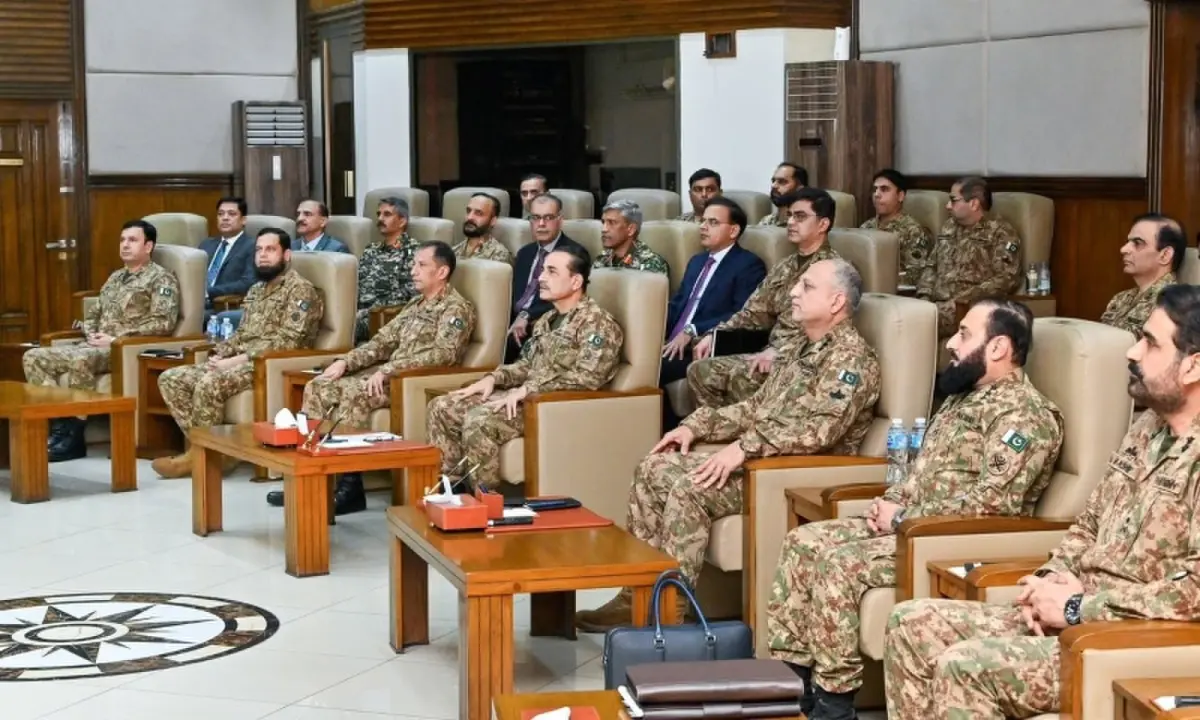
Field Marshal Asim Munir, who serves as Chief of Defence Forces and Chief of the Army Staff, has said Pakistan’s armed forces will continue their counterterrorism campaign against Indian-sponsored terrorist groups “to the fullest”. The military’s media wing said on Friday that he vowed to “hit them hard wherever they are”. He made the remarks during a visit to the Corps Headquarters in Peshawar, the capital of Khyber Pakhtunkhwa (KP), where he was briefed on the security situation and on the readiness of troops in the province.
The statement came at a time when violence has been rising sharply. A recent report from the Centre for Research and Security Studies found an 83 per cent increase in violence-linked fatalities in Pakistan during the third quarter of 2026. For people living in KP and neighbouring Balochistan, the numbers describe weeks of funerals, closed roads and police and soldiers killed on duty. The army’s message is aimed at those communities as much as at the militants.
What Munir Told Commanders in Peshawar
The Inter-Services Public Relations, known as the ISPR, is the army’s official public information body. It issues statements on military operations and on the remarks of senior officers, and it is usually the first official word on events in areas where journalists cannot always reach the scene quickly. The ISPR said that Munir was received at the Corps Headquarters by the Peshawar Corps commander, and that he was then briefed on the security situation, ongoing counterterrorism operations, border management measures and the operational preparedness of formations deployed in KP.
During the visit, he praised the morale and professionalism of the armed forces. He directed them to maintain “vigilance and the highest standards of operational readiness to effectively counter threats”. In plain terms, he was telling commanders to stay alert and keep their units ready to respond at short notice.
The ISPR also said Munir paid tribute to the security personnel who had been killed. He added that “with the support of the people, Pakistan will surely inflict total defeat on the terrorists and their perverted ideology”. That line does more than set a military goal. It asks the public to stand behind the campaign and presents the fight as a national task rather than a job for soldiers and police alone. Whether that appeal lands will depend partly on how the army handles the civilian cost of its operations.
Governor’s Rule and the Apex Committee in Peshawar
A day earlier, Munir attended a meeting of the KP apex committee at the Governor House, where the province’s overall security situation was reviewed. Apex committees are high-level forums that bring together civilian and military leaders to review law and order in a province. Their decisions shape how police, paramilitary forces and the army share responsibility on the ground, so the presence of the army chief at such a meeting signals that the military is deeply involved in the province’s security planning.
Prime Minister Shehbaz Sharif chaired the meeting. He said the federal government, which now runs KP under governor’s rule, would make every effort possible to “bring back” progress to the province. Under governor’s rule, the elected provincial government is set aside and the province is run by a governor acting for the federal authorities in Islamabad. It is an unusual step, and the prime minister’s words show that the centre sees restoring the province’s progress as its own responsibility.
The ISPR statement did not list every decision taken at the meeting. What it does make clear is that the prime minister and the army chief were both in the room while the province’s security was discussed. That combination tells residents that the federal government and the military are treating KP as a priority at the same time.
The 83 Per Cent Jump in Third-Quarter Violence
The military’s emphasis comes against the figures in the Centre for Research and Security Studies report. According to the report, Pakistan recorded an 83 per cent increase in violence-linked fatalities during the third quarter of 2026. That rise reversed a declining trend seen in the first and second quarters. Deaths from terrorism and from counterterrorism operations both increased across the country.
The report found that Balochistan and KP remained the main centres of violence. Balochistan recorded 829 deaths, nearly 59 per cent of the national total. The concentration of deaths in these two areas explains why the army is focusing its statements and operations there.
The term “violence-linked fatalities” covers two kinds of death. Some are people killed in attacks by militant groups. Others are militants, and sometimes civilians caught in the middle, who die during security operations. A rise in the total can therefore mean more attacks, more operations, or both. The report’s figures do not, on their own, show which side of that equation drove the increase, but the reversal of earlier declines is a sign that the security situation worsened after a period of improvement.
For readers outside Pakistan, the numbers can be hard to picture. Put simply, hundreds of people in each of these two provinces died in a single quarter in violence linked to militancy and the response to it. Those deaths fall on families, on schools and markets, and on the roads that people use to get to work. They also fall on the police and soldiers whose deaths the army has been publicly marking.
Karak, Balochistan and the Week’s Clashes
The campaign has also been playing out in a series of recent clashes. The ISPR pointed to several of them. A day earlier, four policemen, including two officials, were martyred and two terrorists were killed during an exchange of fire in Karak, a district in KP. “Martyred” is the term Pakistani officials use for security personnel killed in the line of duty, and it appears in nearly every official statement about these deaths.
On October 19, an army major was martyred and four terrorists were killed during intelligence-based operations in Balochistan. These operations, known as IBOs, are raids carried out on the basis of specific intelligence about a group or a location. They are narrower than a broad sweep of an area, but they still carry risk for the troops who carry them out, as the death of the army major shows.
The day before that, security forces killed eight “India-sponsored” terrorists during IBOs in the Quetta, Nushki and Khuzdar districts of Balochistan. Quetta is the provincial capital, while Nushki and Khuzdar are districts in the same province. The operations spread across several districts in a single day, which gives a sense of how wide the area under pressure is.
Taken together, the events show a pattern. Police in KP and army personnel in Balochistan came under fire within the same stretch of days, and both provinces are being asked to absorb losses at the same time. Each death adds to the pressure on units that already cover large, difficult terrain.
Why the Army Calls Them Indian-Sponsored
The phrase “Indian-sponsored” appears in each of the military’s statements. Pakistan has long accused India of backing militant groups that operate on its territory. India has rejected those accusations. The army’s language ties the current campaign to that long-running dispute, so each operation carries a political message as well as a security one.
This framing matters beyond Pakistan’s borders. When the army describes militant groups as backed from abroad, it shapes how the public, the government and neighbouring countries understand the violence. It also raises the stakes of any cross-border incident. A military that describes its enemies as sponsored by a neighbour has less room to treat an attack as a purely domestic crime, and the rhetoric can make de-escalation harder when tensions are already high.
For ordinary people, the framing has a more immediate effect. It tells them that the state sees the fight as a defence of the country, which can build support for the operations. It can also make it harder for those who question the methods of the campaign to be heard, especially when the army asks the public for its backing.
What the Next Phase Could Mean for KP and Balochistan
The first test is whether violence starts to fall. Munir’s promise to hit groups “wherever they are” suggests that operations will continue at their current pace, at least in the near term. That could mean more raids in Balochistan and KP, and more pressure on districts such as Karak, where police have recently been attacked. It could also mean more intelligence-based operations of the kind that killed the army major’s attackers and the eight militants in Quetta, Nushki and Khuzdar.
The second test is political. Shehbaz Sharif has said the government will work to bring progress back to KP while the province is under governor’s rule. If the security situation improves, the government will be able to argue that its approach is working. If the casualty figures keep rising, it will face harder questions about whether military operations alone can bring the violence down, and about what the civilian side of the government is doing to address the causes of unrest.
The third question is the cost to ordinary people. The quarterly totals are made up of police officers, soldiers and civilians, many of whose names reach the public only through local reports. How the army and the government protect civilians during operations, and how they explain their actions to the communities involved, will shape how much support the campaign keeps. Munir has said the country needs “the support of the people”. That request will be tested in the months ahead, especially if the next quarterly figures show the same upward trend.
The next official figures, from the army or from research groups such as the Centre for Research and Security Studies, will show whether the third-quarter rise was a spike or the start of a longer trend. Until then, the army’s words and the casualty numbers will be read side by side.
Questions and answers
What did Asim Munir say about terrorist groups?
Field Marshal Asim Munir said the armed forces would continue the campaign against Indian-sponsored terrorist outfits “to the fullest” and would “hit them hard wherever they are”, according to the military’s media wing, the ISPR. He made the remarks during a visit to the Corps Headquarters in Peshawar on Friday.
Why did violence in Pakistan rise in 2026?
A Centre for Research and Security Studies report recorded an 83 per cent increase in violence-linked fatalities in the third quarter of 2026. The report said the rise reversed a decline seen in the first and second quarters, with Balochistan and KP remaining the main centres of violence.
Why is Khyber Pakhtunkhwa under governor’s rule?
The federal government now runs KP under governor’s rule, which means the elected provincial government is set aside. Prime Minister Shehbaz Sharif chaired a KP apex committee meeting at the Governor House, where he said the government would make every effort to bring back progress to the province.
What happened in Karak and Balochistan recently?
In Karak, four policemen, including two officials, were martyred and two terrorists were killed in an exchange of fire. On October 19, an army major was martyred and four terrorists were killed in intelligence-based operations in Balochistan.
Topics: Asim Munir, Khyber Pakhtunkhwa, Balochistan, ISPR, Pakistan army, Peshawar Corps, Shehbaz Sharif, counterterrorism
Sources: Dawn