
F-22 Pilot Controls Anduril's Fury Drone Wingman in Flight Test
Air Force says the fighter pilot acted as an airborne 'quarterback,' directing an uncrewed wingman's onboard autonomy software in real time
By AXY Defense Desk ·
Key points
- An F-22 Raptor pilot controlled an Anduril-built YFQ-44A Fury uncrewed jet in flight, the Air Force announced earlier this month.
- The pilot acted as an airborne “quarterback,” giving high-level directives that the drone's onboard software carried out in real time.
- The Air Force plans 500 combat-ready semi-autonomous CCA by 2032, within a 1,000-aircraft fleet.
- The Fury completed a beyond-line-of-sight live-fire strike against a simulated target at Edwards Air Force Base in July.
- General Atomics' FQ-42A Vengeance was delivered to Creech Air Force Base in Nevada last month for continued testing.
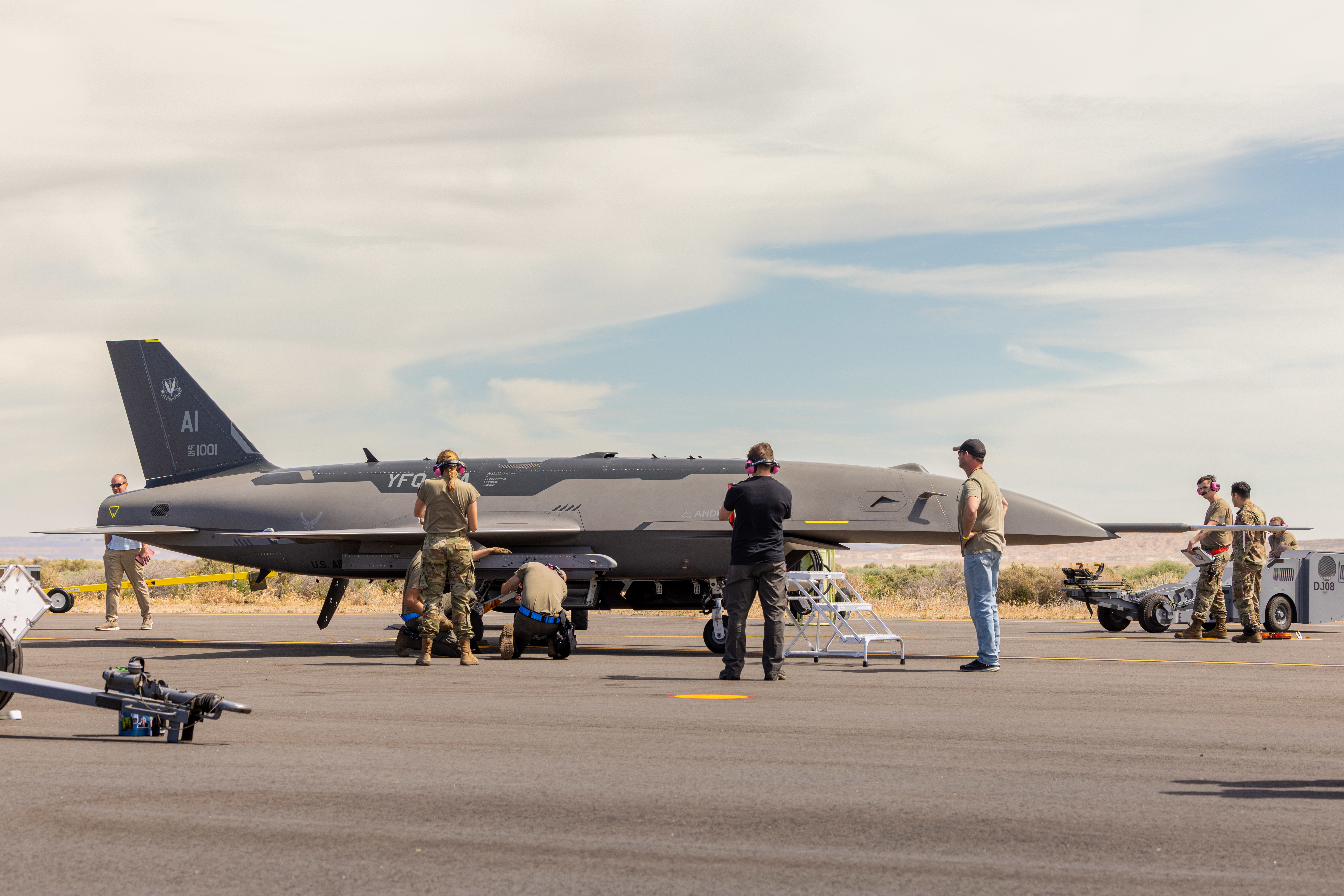
The US Air Force has said an F-22 Raptor pilot controlled an uncrewed YFQ-44A Fury collaborative combat aircraft in flight, a milestone in the service's effort to field drones that fly alongside manned fighters. The Air Force announced earlier this month that the F-22 completed airborne tactical command and in-flight control of the Anduril-made aircraft, according to a report published by Defense News on October 20, 2026.
In the demonstration, the fighter pilot acted as what the Air Force called an airborne “quarterback.” The pilot gave high-level directives to the Fury, and the aircraft's onboard autonomy software interpreted and carried them out in real time. The uncrewed jet performed in-flight maneuvers and simulated combat tasks, according to the service's release.
“This achievement demonstrates what is possible when we are aligned with industry on a shared imperative: delivering capability to the warfighter at unprecedented speed,” Secretary of the Air Force Troy Meink said in the announcement. “We are driving urgency into every part of acquisition from rapid integration and flight learning to disciplined assessment, so we can turn promising technology into combat capability at the pace the threat demands.”
The Air Force said personnel from several units worked on the demonstration, including the 412th Test Wing, the 422nd Test and Evaluation Squadron, the 309th Software Engineering Group, the Experimental Operations Unit, the F-22 System Program Office and the CCA Software Autonomy and Teaming Branch.
What the Test Showed
The key point of the flight is the division of labor between the two aircraft. In a conventional setup, a pilot flies a single jet and controls its sensors and weapons directly. In this test, the pilot instead issued instructions at a higher level, leaving the detailed flying of the drone to the aircraft's software. The Air Force describes the uncrewed jet as semi-autonomous, meaning it can carry out many tasks on its own once it receives direction, while humans still set the overall goals.
This approach is central to what the Air Force hopes its collaborative combat aircraft, or CCA, will do. Officials have described the drones as a way to add mass and options to an air fight without putting more pilots at risk. A crewed fighter could, in principle, send uncrewed aircraft ahead to scout, jam enemy radars or carry weapons, while the pilot stays further back and makes the key decisions. The Air Force said it will use data from this flight to inform software integration, developmental testing and future CCA concepts, though the release did not describe the specific data or next flights.
Background on the Collaborative Combat Aircraft Program
The term “loyal wingman” refers to an uncrewed aircraft that follows and supports a manned fighter. The idea has been discussed by several air forces for years, but building one that can fly reliably with human-piloted jets and respond to commands in combat-like conditions is a more difficult engineering problem. The CCA program is the Air Force's attempt to turn that concept into fielded aircraft.
The Air Force has said it intends to have 500 combat-ready, semi-autonomous CCA by 2032, within an overall fleet of 1,000 aircraft, according to the report. That goal shows how the service views these drones: not as a small test project but as a large part of future air combat forces. The F-22 Raptor, the fifth-generation stealth fighter built by Lockheed Martin, is one of the most capable crewed fighters in service, and pairing it with uncrewed aircraft is intended to extend its reach.
The program is not limited to a single company. The Fury is built by Anduril, a defense technology company founded in 2017, and it is one of the designs the Air Force is testing. Alongside it, the service has been working with General Atomics, which makes the FQ-42A Vengeance. Two different designs under evaluation give the Air Force room to compare performance, cost and how well each fits with existing fighters.
The Fury and Vengeance Programs
The Fury's progress has included a notable live-fire event. According to the report, the aircraft carried out its first live-fire test in July at Edwards Air Force Base in California, where it conducted an end-to-end, beyond-line-of-sight strike against a simulated target. A beyond-line-of-sight strike is one that is controlled or guided from a distance where the operator cannot see the target directly, which is important for drones that may need to operate far from their controllers.
The General Atomics aircraft also advanced recently. The FQ-42A Vengeance was delivered to Creech Air Force Base in Nevada last month to continue regular test and evaluation operations, according to the report. Testing at multiple bases spreads the work across different ranges and mission types, and it helps the service gather more data more quickly.
The report also described a training exercise at Creech. Airmen there conducted an Agile Combat Employment exercise using Anduril's aircraft. Agile Combat Employment is a concept in which aircraft are dispersed to smaller, more austere locations so that they are harder to target and can keep operating. In that exercise, airmen completed sorties and built basic tactics and procedures that the service expects will shape how CCA are integrated into the force. Anduril has not yet announced which Air Force base will host the Fury.
Why Manned-Unmanned Teaming Matters
For readers outside the defense field, the significance of this test lies in how wars could be fought and paid for. Fighter jets are expensive, and pilots take years to train. If uncrewed aircraft can be produced in larger numbers at lower cost and flown in risky missions, a smaller number of crewed fighters could command a much larger force. That prospect is a main reason the Air Force is pushing to speed up acquisition, as Meink's comments emphasized.
The test also raises technical and policy questions that analysts are likely to watch closely. Software that can interpret high-level commands and act on them in real time must be reliable and secure, and must behave predictably when conditions change. Military officials and independent observers have long debated how much decision-making authority should rest with machines, especially in combat. The Air Force's description of the Fury as semi-autonomous, with a human pilot setting the directives, reflects an approach that keeps people in charge of the overall mission while letting software handle many of the moment-to-moment details.
The pace of work is another factor. Meink's remarks suggest the service wants to shorten the time between a technology demonstration and a usable combat capability. Whether that pace can be sustained through the testing, integration and production stages is a question that will matter as the 2032 goal approaches.
What Comes Next
The Air Force has said the data from this flight will feed into software integration, developmental testing and further CCA concepts. Those steps will show whether the autonomy software can handle a wider range of tasks, more aircraft at once and more complicated combat scenarios. Analysts expect future tests to build on the pilot-to-drone command approach demonstrated here, though the Air Force has not announced specific dates or follow-on flights in the source material.
Other things to watch include which base will host the Fury, how the FQ-42A Vengeance performs at Creech, and whether the service announces additional live-fire or manned-unmanned teaming events. Each of those developments would indicate how close the CCA program is to moving from test flights into regular operations.
Questions and answers
What did the F-22 pilot do during the Fury test?
The pilot acted as an airborne “quarterback,” giving high-level directives to the YFQ-44A Fury. The drone's onboard autonomy software interpreted and carried out those directives in real time, performing in-flight maneuvers and simulated combat tasks.
What is the Collaborative Combat Aircraft program?
The Collaborative Combat Aircraft program is the US Air Force's effort to field semi-autonomous uncrewed aircraft that fly alongside crewed fighters. The service has said it intends to have 500 combat-ready CCA by 2032, within an overall fleet of 1,000.
Where has the Fury been tested?
According to the report, the Fury conducted its first live-fire test in July at Edwards Air Force Base in California, carrying out an end-to-end, beyond-line-of-sight strike against a simulated target. Anduril has not yet announced which Air Force base will host the aircraft.
What happens next for the CCA program?
The Air Force said it will use data from this flight to inform software integration, developmental testing and further CCA concepts. The General Atomics FQ-42A Vengeance is also continuing testing at Creech Air Force Base in Nevada.
Topics: F-22 Raptor, YFQ-44A Fury, Anduril, Collaborative Combat Aircraft, US Air Force, General Atomics, Manned-unmanned teaming
Sources: Defense News
https://axynewsglobal.com/article/f-22-pilot-controls-anduril-s-fury-drone-wingman-in-flight-test