
Europe Weighs Letting Utilities and Infrastructure Firms Shoot Down Drones
France has already passed a law, Germany and Austria are reviewing similar powers, and Poland's operators say legal questions remain unresolved
By AXY Defense Desk ·
Key points
- France passed a law in August allowing approved critical infrastructure operators and contractors to detect, jam and shoot down drones near designated facilities.
- Eurelectric warned that heating outages this winter are a possibility due to hybrid attacks.
- Reuters interviews found counter-drone technology is advancing faster than the rules governing who may use it.
- Germany is reviewing the legal role of infrastructure operators, and Austria has announced plans to give similar powers to operators including large energy firms.
- Liability and legal authority remain unresolved, and Poland's energy operators say they still need clearer assurances.
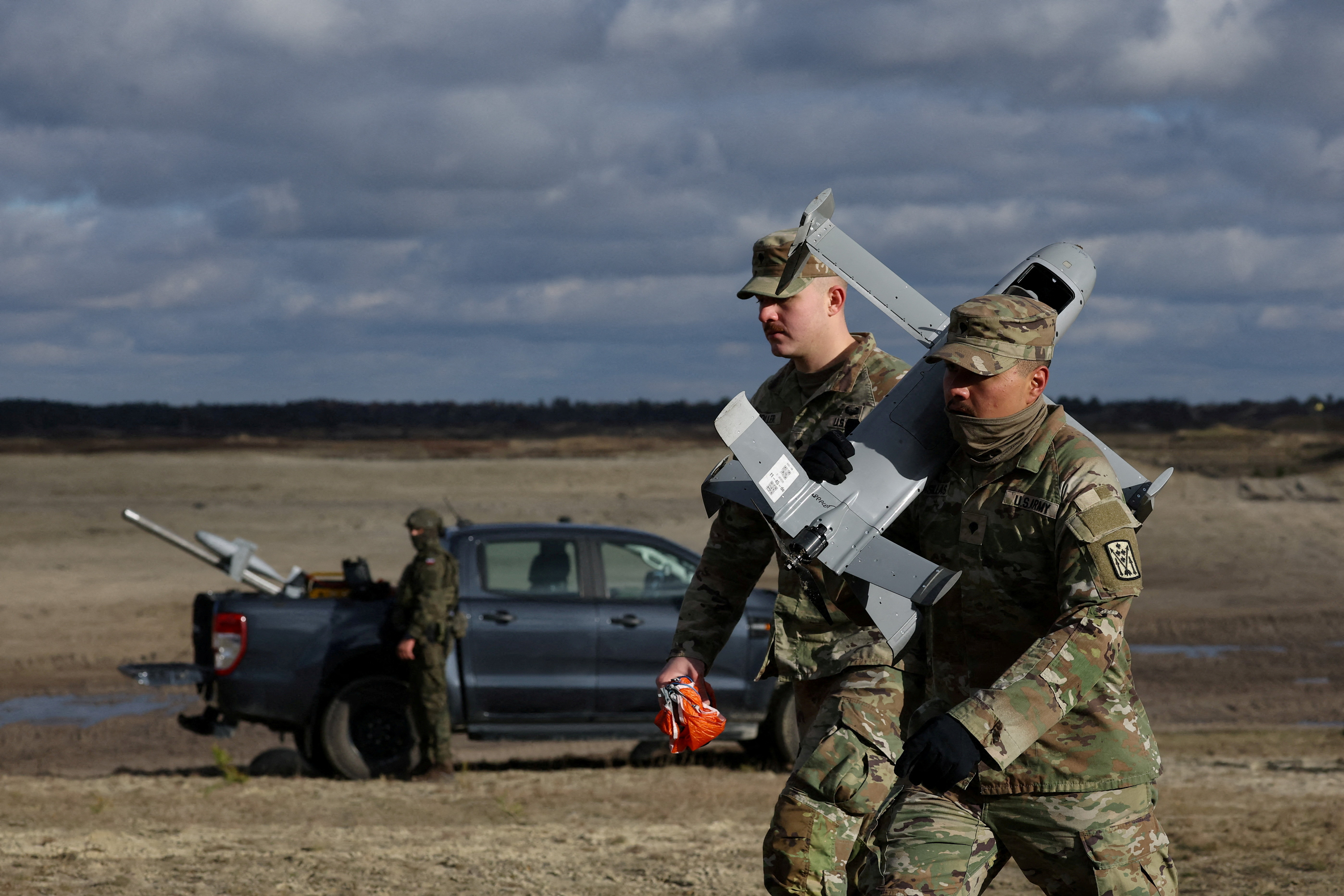
At a former flight-test base at Brétigny-sur-Orge, south of Paris, drones fly low over fields and woodland while teams on the ground try to stop them. The site is where governments test systems designed to counter unwanted drones, including electronic jammers that disrupt a drone's radio link and interceptor drones that fly into a target to bring it down. What has changed is who wants to buy this equipment. The customers are no longer only governments, police forces and armies. Private companies and state-owned entities that run critical infrastructure across Europe want to protect their sites, and some utilities are asking for permission to shoot drones down themselves.
Why the question is moving up the agenda
The concern follows a steady rise in drone incursions over European sites since Russia invaded Ukraine in 2022. Many of the incidents are described as hybrid attacks, a term used for hostile actions that mix sabotage, cyber operations, disinformation and other tools short of open war. Governments are worried that a drone strike or hybrid attack could knock out power for millions of people, as has happened repeatedly in Ukraine after Russian strikes on its energy grid.
The risk is not only theoretical for the energy sector. Kristian Ruby, secretary general of Eurelectric, the European electricity industry association, told Reuters: "It is a theoretical, and increasingly a practical, possibility that there could be heating outages this winter due to hybrid attacks." For households, a winter outage would mean no heat, and for hospitals and care homes it could be far more serious. Eurelectric's warning shows why utilities now see drone defence as part of keeping the lights and heating on, not a niche security matter.
France moves first
France has gone furthest so far. Its parliament passed a law in August that allows approved operators of critical infrastructure and their contractors to detect, jam and shoot down drones near designated facilities. The law followed a wave of drone flights over critical and military sites, including flights over the Ile Longue nuclear submarine base near Brest in northwestern France in December 2025.
A senior French official involved in the plans told Reuters that the government wants a newly expanded list of sensitive sites considered of vital importance to be equipped by 2027. The official asked not to be named because the details are not yet public. The official also described the mood behind the policy: "We were defenseless in the face of the (drone) threat," and said concern had grown over the last decade as unmanned aerial vehicles became more accessible and more common.
Under the plan, operators such as the state-owned utility EDF and the state-owned railway SNCF would be offered a catalogue of approved systems. The range runs from electronic jammers to interceptor drones, with the right choice depending on the setting and the threat. Systematic Paris-Region, which runs the government testing programme at Brétigny-sur-Orge, said evaluations launched this summer had so far catalogued three systems integrators, companies that combine different computer systems into one working whole, and 17 counter-drone systems. It said assessments were continuing and that work was under way to speed up buying from among those solutions.
France's defence ministry said the August law would help strengthen the country's ability to counter the threat. It added that it could speak only for critical infrastructure under its own authority. EDF and SNCF declined to comment.
Who is allowed to act?
The central problem is legal, not technical. Reuters interviews with more than 30 company executives, officials and drone experts found that the technology to detect and bring down drones is maturing faster than the rules on who may use it. Approaches differ widely from country to country, and legal uncertainty remains, including over who has the right to order a response to a drone threat in the first place.
The stakes for companies are practical. A drone brought down over a town, a road or a rail line can fall on people or property. That raises hard questions about liability and accountability. If a utility's security team brings down a drone and the wreckage injures a passer-by, it is not yet clear in every European country who would answer for that. Lawyers and insurers will want clear answers before private operators take on that role at scale.
The Leipzig/Halle incident in August showed how quickly the risk can move across borders. Investigators found an explosives-laden drone near a Ukrainian cargo plane at Germany's Leipzig/Halle airport. Germany blamed Russia for the incident. Moscow denied being behind it and has repeatedly denied carrying out hybrid attacks in Europe, many of which have targeted countries that support Kyiv in Russia's war in Ukraine.
Germany and Austria consider their options
In Germany, counter-drone work remains a policing task. The interior ministry told Reuters it was reviewing how operators of critical infrastructure and third parties could be legally involved in active counter-drone measures. That review matters because Germany's energy grid, rail network and airports are spread over a large area, and the government has signalled that the state alone cannot cover every site.
Austria went further in September. It announced plans to give similar powers to critical infrastructure operators, including large energy firms. Defence Minister Klaudia Tanner told a press conference that the state could not protect every site on its own. Her comment captures a wider concern. Protecting many scattered sites, such as substations, pipelines and transmission lines, is hard for any national police or military force to do alone, and relatively cheap drones can cause costly damage.
Poland's experience on the eastern flank
Poland has moved further than many of its neighbours in practice. Operators told Reuters they have deployed counter-drone systems and trained with military and police units. Drone-restricted zones have been set up around critical energy infrastructure. Designated security units working for those operators have been authorised to destroy, disable or take control of drones that enter these zones.
Still, two sources at energy transmission companies on NATO's eastern flank told Reuters that effective intervention still needs more assurances and perhaps a judicial precedent on who has the authority to act when a drone appears. Their comments suggest that even where the equipment and training are in place, the legal authority to use them is not yet settled. A court ruling could give companies the confidence they say they need, but none has been reported as yet.
What to watch next
Several developments will show whether this shift takes hold. The first is the French list of sensitive sites, which the government wants equipped by 2027, and whether the catalogue of approved systems is turned into actual purchases. The second is whether Germany and Austria produce legal frameworks that clearly name who may act, and under what conditions. The third is whether any court case tests the liability questions that companies have raised.
Analysts would likely expect the debate to focus on three things: clear command and control, so that a private operator knows when it may act; insurance and liability rules; and coordination with police and the military, so that a drone shot down over one site does not create a risk somewhere else. Whether Europe can settle those questions before the winter, when Eurelectric has warned of possible heating outages, may determine how quickly utilities are given these powers.
Questions and answers
Why do European utilities want the power to shoot down drones?
Utilities and infrastructure operators want to protect sites that are widely spread out and could be hit by drones or hybrid attacks. Eurelectric has warned that heating outages this winter are a possibility due to such attacks.
Has France given companies the power to shoot down drones?
Yes. France's parliament passed a law in August allowing approved operators of critical infrastructure and contractors to detect, jam and shoot down drones near designated facilities. The government wants a newly expanded list of sensitive sites equipped by 2027.
What are the main legal problems with letting companies shoot down drones?
Legal uncertainty remains over who has the right to order a response to a drone threat. Bringing down a drone could injure people on the ground or damage property, raising questions about liability and accountability.
What is happening in Germany and Austria?
Germany's interior ministry is reviewing how critical infrastructure operators and third parties could be legally involved in counter-drone measures. Austria announced plans in September to give similar powers to critical infrastructure operators, including large energy firms.
Topics: counter-drone systems, critical infrastructure, France, Germany, Austria, Poland, hybrid attacks, Eurelectric
Sources: Defense News