
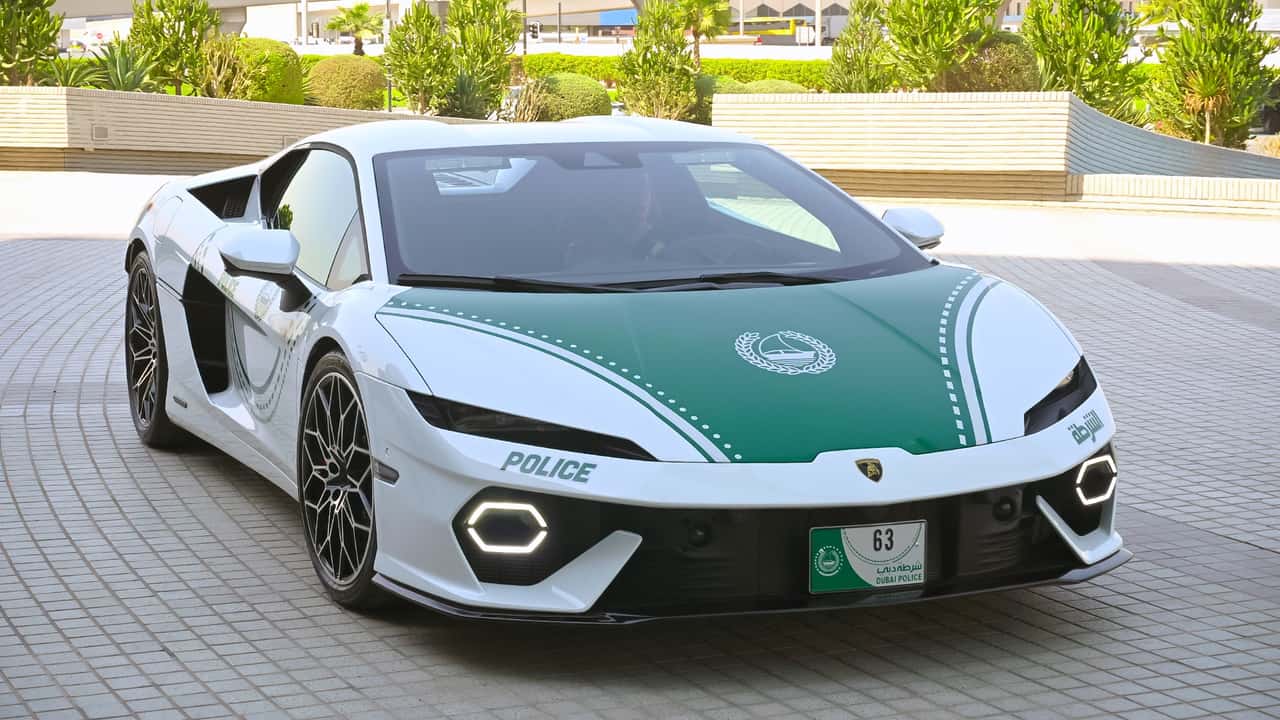
Dubai Police Adds 907-HP Lamborghini Temerario to Its Patrol Fleet
The plug-in hybrid supercar joins Dubai's high-performance patrol fleet, and the report confirms its 907-horsepower rating but few other details
By AXY Autos Desk ·
Key points
- Dubai Police has added a 907-hp Lamborghini Temerario to its fleet of high-performance patrol cars, according to Motor1's report published on 18 October 2026.
- The Temerario is a plug-in hybrid sports car that combines a twin-turbocharged V8 engine with electric motors.
- The report does not confirm the number of vehicles added, the service start date, the assigned duties or the cost.
- Supercars in police fleets are generally associated with visibility, public engagement and operational flexibility, but the source does not state the purpose for this car.
Dubai Police has added a 907-horsepower Lamborghini Temerario to its fleet of high-performance patrol cars, according to a report by Motor1 published on 18 October 2026. The report confirms the addition of the car and its rated output, and places it within a force that has become one of the most widely recognised police operations in the world for its use of expensive sports and luxury cars.
The Temerario is a two-seat sports car built by Lamborghini, the Italian manufacturer owned by the Volkswagen Group. It is the successor to the Huracán, a V10-powered model that Lamborghini produced for roughly a decade before the Temerario arrived. The Temerario uses a twin-turbocharged V8 engine combined with electric motors, which makes it a plug-in hybrid. The 907-horsepower figure cited in the Motor1 report is the number that draws the most attention, because it places the car among the most powerful road-going models the company sells.
The verified details of the announcement are narrow. Dubai Police has added the car to its fleet. The vehicle is a Lamborghini Temerario rated at 907 horsepower. The fleet is described as high-performance patrol cars. Motor1, a car news publisher, reported the addition on 18 October 2026. Beyond those points, the source material does not provide the information that usually accompanies an official vehicle announcement.
What the Report Confirms and What It Leaves Out
The report does not state how many Temerarios the force has acquired, when the car entered service, which unit or district it will be assigned to, or what it cost. It also does not describe any markings, equipment or operating rules for the vehicle. Those gaps matter because they determine how the car will actually be used, and they cannot be filled in from the source material without speculation.
A lack of detail is not unusual when a vehicle addition is publicised mainly through media coverage and social channels rather than a full official release. Police forces often confirm such acquisitions in short statements or images before releasing fuller information about deployment. Readers should therefore treat the points that are not in the report as unconfirmed until Dubai Police or another reliable source provides them.
How Dubai Police Came to Use Supercars
Dubai has used high-performance vehicles in its police fleet for many years, and the practice has become a familiar part of the emirate's public image. Sports and luxury cars from manufacturers such as Lamborghini, Ferrari, McLaren, Aston Martin and Bugatti have been seen in patrol, public-engagement and special-event roles. Images of these vehicles are widely shared online, which has helped make the Dubai force one of the most photographed police operations in the world.
The approach is closely associated with visibility and public engagement. Many police forces use distinctive vehicles at community events, school visits and promotional campaigns, because they attract attention and make the police more approachable. Dubai's use of supercars is among the most prominent examples of this strategy, and it sits alongside the emirate's broader efforts to present itself as a safe, modern and well-run destination for residents, visitors and investors.
Possible Purposes for a Fast Patrol Car
The source material does not say why the Temerario was added, but policing commentators generally point to three possible purposes for vehicles of this kind. The first is deterrence and visibility. A recognisable police car is intended to remind drivers that enforcement is present, and some analysts argue that a striking vehicle can influence driver behaviour more than an ordinary patrol car does. The second is public relations. High-performance vehicles attract attention in news coverage and on social media, which can help a force communicate its work to a wide audience.
The third purpose is operational. A fast vehicle can be useful for specific tasks, such as escorting, responding to incidents on high-speed roads or supporting enforcement where speed is a factor. Whether any of these roles applies to the Temerario is not stated in the report, and it is possible that the car serves a combination of purposes. The answer would shape how its costs and benefits are judged, so it is one of the most important questions that remains open.
Why the Temerario's Technology Matters
The Temerario's specifications are significant because they show how performance cars have moved toward electrified power. A plug-in hybrid combines a combustion engine with a battery and electric motors. The battery can be charged from an external power source, and the electric motors can add power to the engine, particularly during acceleration. This arrangement allows a car to deliver very high output while also offering short stretches of electric-only driving, depending on the model and the driving mode selected.
For a police fleet, that technology raises practical questions that are common to specialist vehicles. High-performance cars generally require trained drivers, specialist maintenance and parts that can be costly or slow to obtain. Hybrid systems add their own servicing requirements, including high-voltage components that must be handled by technicians with the right training. None of these issues is addressed in the source report, but they are the kinds of considerations that determine whether a specialist vehicle can be used routinely or mainly for limited and high-profile tasks.
Reactions, Reputation and Public Debate
The announcement is likely to be received in different ways. For car enthusiasts, the arrival of a 907-horsepower Lamborghini in a police fleet is a notable development because it shows how performance vehicles are now used in mainstream public service. For road safety specialists and members of the public, the more relevant questions concern how often such vehicles are deployed in traffic enforcement, whether they are used on public roads during ordinary duties, and whether high-performance models change how drivers react to police cars. The source material cannot answer those questions.
There is also a reputational dimension. Dubai has invested heavily in its image as a modern, well-policed city, and vehicles that are widely photographed and shared can reinforce that image. Critics of such displays sometimes argue that the money spent on specialist cars could be directed toward other needs, such as training, technology or community programmes. Supporters argue that visibility and brand value can be part of a legitimate public-safety strategy, particularly in a city that depends heavily on tourism and international reputation. Both views are common in wider debates about police fleets, and they are presented here as general arguments rather than positions taken in the source report.
What to Watch Next
Several developments would clarify the story. An official statement from Dubai Police would confirm how many vehicles have been added, when the Temerario entered service, what duties it has been assigned and whether any operating rules apply to its use. Further coverage could show whether the car will be used at public events, in traffic enforcement or in emergency response. Readers may also watch whether the force adds other models to the fleet. A single acquisition would suggest a targeted addition, while several new models would point to a broader plan for the fleet.
It will also be worth watching how the Temerario is presented in official communications. Police forces that use high-performance vehicles often publish images and video, and the framing of those materials can indicate whether the emphasis is on public engagement, specialised capability or both. Until more information is released, the verified facts remain limited to the addition of the car to the fleet and its rated power of 907 horsepower.
The addition of the Temerario is a small but revealing example of how police forces adapt to a market in which performance cars are increasingly hybrid and technically complex. For Dubai, it reinforces a long-standing identity built around high-profile vehicles. For readers, it offers a view into how public institutions balance image, practicality and public trust when they decide what to put on the road.
Topics: Dubai Police, Lamborghini Temerario, Lamborghini, Police patrol cars, Supercars, Plug-in hybrid vehicles, Dubai, Motor1
Sources: Motor1
https://axynewsglobal.com/article/dubai-police-adds-907-hp-lamborghini-temerario-to-its-patrol-fleet