
Dakota Meyer Named Senior Advisor to Pentagon Barracks Task Force
Medal of Honor recipient will inspect bases nationwide, starting with three California installations this week
By AXY Defense Desk ·
Key points
- Defense Secretary Pete Hegseth appointed Medal of Honor recipient Dakota Meyer as senior advisor to the Pentagon’s Barracks Task Force.
- Meyer’s first visits are to Camp Pendleton, Twentynine Palms and Miramar in California, and a map shown in the video indicated 21 bases by the end of December.
- The task force was formed in October 2025, and a GAO report estimated $285 billion in maintenance backlogs in fiscal 2025.
- Recent funding includes $1.2 billion for barracks improvement and $1 billion for military housing restoration under the July 2025 law.
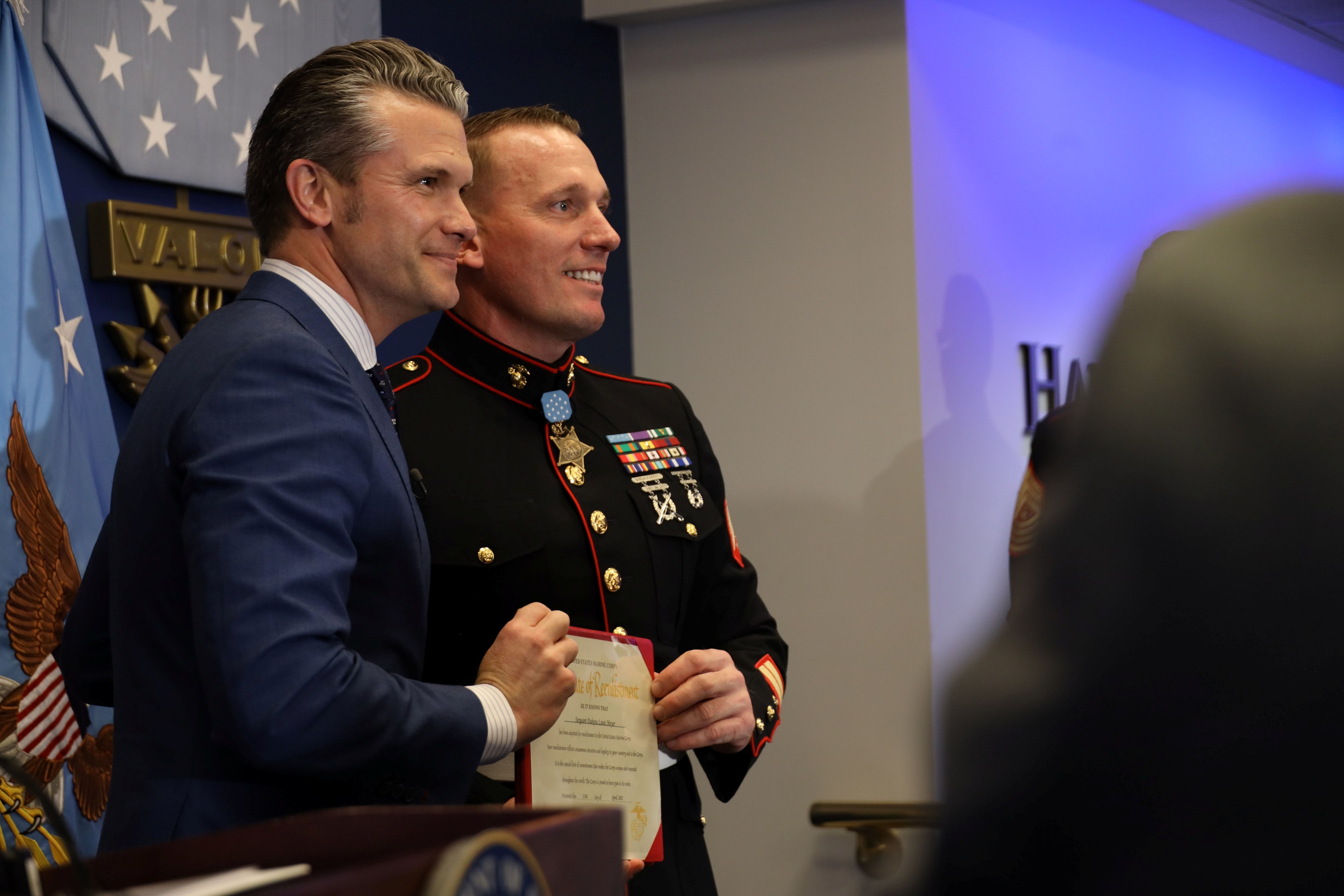
Defense Secretary Pete Hegseth has appointed Medal of Honor recipient Dakota Meyer, a U.S. Marine Corps reservist, as senior advisor to the Pentagon’s Barracks Task Force, the department’s effort to address what Hegseth has described as “unacceptable” living conditions in military barracks. Hegseth announced the appointment on Monday in a video posted on social media, and Military Times reported the news on October 20. In the new role, Meyer will travel to military installations across the country, look at their barracks, meet with service members and identify how to remove obstacles that block solutions.
Meyer’s first stops are all in California. According to the reporting, he is scheduled to visit Marine Corps Base Camp Pendleton on Tuesday and Wednesday, followed by Marine Corps Air Ground Combat Center Twentynine Palms on Thursday and Marine Corps Air Station Miramar on Friday. A map displayed in the video showed that, if the schedule holds, Meyer will have visited 21 bases across the country, most of them along the East Coast, by the end of December.
In the video, Meyer framed the mission in terms of the people who live in the barracks. “Our warfighters should be focused on training, readiness and defending this great nation,” he said. “They shouldn’t have to fight for basic living conditions when they come home at night.”
Hegseth encouraged service members and base leaders to pay attention to Meyer’s visits. “I want you to ask this question for the next couple of months: Where’s Dakota?” Hegseth said. “Could he be coming to my base, to my installation, to my camp, my fort? Because he might be.” He added that Meyer would be “holding town halls, getting real input, and then providing real solutions” on behalf of the task force and of Hegseth personally.
Why the Barracks Task Force Exists
Barracks are the buildings where junior enlisted service members, typically those early in their careers, live on or near military bases. Their condition affects daily life, sleep, privacy and health, and it can influence whether people choose to stay in uniform. The Pentagon, which is the headquarters of the Defense Department, has long managed these buildings through individual military services, such as the Army, Navy, Marine Corps, Air Force and Space Force, each with its own installations and budgets.
Hegseth first formed the Barracks Task Force in October 2025. It is led by the assistant secretary of defense for energy, installations and environment, a senior civilian official responsible for military bases and their upkeep. According to the reporting, the task force has two main jobs: identifying investment opportunities to improve barracks, and creating department-wide policies for barracks standards. Standards matter because they set a common baseline for what a service member can expect, regardless of which base they are assigned to.
The appointment of a senior advisor adds a different element. Task forces usually work through policy documents and budget decisions, which can be slow to reach the people affected. A visible figure who travels to bases, speaks with troops and reports back could make the effort more concrete, though it will depend on whether the findings lead to funded repairs and enforceable standards. Analysts who follow military housing generally point to that gap between announcements and completed work as the central test for efforts of this kind.
Funding and Oversight Concerns
Money is a major part of the picture. According to the reporting, the One Big Beautiful Bill Act, the reconciliation law signed in July 2025, gave the Defense Department $1.2 billion for barracks improvement. Of that amount, $230 million was allotted to the Marine Corps Barracks 2030 initiative and $425 million to enlisted boot camp barracks and other related facilities. The law also provided $1 billion for restoration and modernization of military housing across the Army, Navy, Air Force and Space Force. The reporting presents these figures as separate allocations, and readers should look to official budget documents for how the money is ultimately spent.
The broader problem is maintenance. A Government Accountability Office report from August found that the Defense Department does not request enough funding to meet its installation maintenance and improvement needs. The Government Accountability Office, or GAO, is the independent audit agency of Congress. Its report estimated that the department faced about $285 billion in maintenance backlogs in fiscal 2025. A backlog is work that has been identified as needed but not yet carried out. The U.S. government’s fiscal year runs from October 1 through September 30, so fiscal 2025 refers to the year that ended in September 2025.
Earlier GAO reports described some barracks as “chronically neglected,” a finding that the reporting says led to poor conditions that affected the quality of life of enlisted service members. A 2023 report found that thousands of service members lived in subpar barracks, and that some of those buildings posed potentially serious health and safety risks. Those findings are part of why lawmakers and military leaders have focused on barracks in recent years, and why the current effort is being framed around accountability.
Recent Projects Already Underway
The reporting says the Barracks Task Force has recently funded several projects at installations across the country. Among them are modernized housing at Fort Stewart-Hunter Army Airfield in Georgia and a housing installation at Naval Base Kitsap-Bremerton in Washington. Fort Stewart is an Army post, and Naval Base Kitsap-Bremerton is a Navy base, so the projects span more than one service. Visible construction at specific bases can give troops and families a sense of progress, although a single project does not by itself resolve a backlog measured in the hundreds of billions of dollars.
For readers outside the military, the scale of the issue is easier to grasp when considered base by base. The Defense Department operates hundreds of installations, and each one has its own mix of buildings of different ages. Meyer’s planned tour, which the map suggested will cover 21 bases by the end of December, is designed to show how conditions vary and where the most urgent problems are. Analysts would likely look for whether those visits produce public findings, a list of priorities and a timeline for repairs.
Meyer’s Military Background
Meyer is a recipient of the Medal of Honor, the highest military decoration for valor in combat awarded by the United States. Former President Barack Obama presented him with the medal in 2011 for his actions during the Battle of Ganjgal in Afghanistan in 2009. According to the reporting, Meyer repeatedly entered an enemy ambush zone to rescue wounded comrades and to recover the bodies of fallen service members. His actions were credited with saving 13 Americans and 23 Afghan personnel.
Meyer left the Marine Corps in 2010. He later reenlisted in the reserves in April 2025, and his oath of enlistment was administered at the Pentagon by Hegseth. That personal connection is part of why the appointment has drawn attention, since Hegseth both swore Meyer back into service and is now assigning him a high-profile task. Military observers often note that a well-known veteran can lend credibility to an initiative aimed at troops and their families, but the value of the role will ultimately be measured by its results.
In the video, Meyer took responsibility for the outcome. “From this point forward, there’s no confusion about who’s accountable,” he posted on social media. “If we don’t get this fixed, there’s only one person to blame. Me.” That statement sets a clear personal benchmark, and it gives service members a named person to hold to account if progress stalls.
What to Watch Next
The immediate test is the schedule. Meyer’s visits to Camp Pendleton, Twentynine Palms and Miramar will show how he approaches inspections, town halls and conversations with service members. The reporting indicates that the tour is expected to reach most East Coast installations by the end of December, so the pace and geographic spread of the visits will be worth following.
The second test is whether the effort produces department-wide standards. Because the task force is charged with creating policies for barracks, observers will look for written guidance that applies across the services, along with a clear way to measure whether those standards are being met. Any such policy would need to be connected to funding decisions, since the GAO’s findings about underfunded maintenance suggest that standards alone may not change conditions without money to carry them out.
The third test is the backlog itself. The $285 billion maintenance backlog cited by GAO is far larger than the barracks-specific funding described in the reporting, which means that the task force’s work will sit inside a much larger challenge. Watchers are likely to compare future budget requests and congressional appropriations with the needs identified during Meyer’s visits. For now, the reporting establishes the appointment, the schedule and the funding background, while the results of the tour remain to be seen.
Questions and answers
Who is Dakota Meyer?
Dakota Meyer is a Medal of Honor recipient and U.S. Marine Corps reservist. Former President Barack Obama awarded him the medal in 2011 for his actions during the Battle of Ganjgal in Afghanistan in 2009.
What will Dakota Meyer do as senior advisor?
As senior advisor to the Barracks Task Force, Meyer will travel to military installations, inspect their barracks, meet with service members and identify how to remove obstacles to fixing problems. Hegseth said he would also hold town halls to gather input.
Where will Dakota Meyer visit first?
His first stops are in California: Marine Corps Base Camp Pendleton on Tuesday and Wednesday, Marine Corps Air Ground Combat Center Twentynine Palms on Thursday, and Marine Corps Air Station Miramar on Friday.
Why was the Barracks Task Force created?
Hegseth formed the task force in October 2025 to identify investment opportunities and create department-wide policies for barracks standards. The effort follows GAO and 2023 reports describing neglected barracks and poor conditions for enlisted service members.
Topics: Dakota Meyer, Pete Hegseth, Barracks Task Force, Pentagon, U.S. Marine Corps, Military Housing, Medal of Honor
Sources: Military Times
https://axynewsglobal.com/article/dakota-meyer-named-senior-advisor-to-pentagon-barracks-task-force