
Autonomy Dominates US Army's 2026 Conference as Pentagon Seeks $50 Billion
Defense officials at the AUSA conference in Washington focused on drones, robotic weapons and a new Army command for autonomous warfare
By AXY Defense Desk ·
Key points
- Defense Secretary Pete Hegseth said the Pentagon is requesting roughly $50 billion in reconciliation funding to scale autonomous and robotic systems.
- The Army ordered creation of the U.S. Army Futures and Autonomous Systems Command (FASCOM) in an Oct. 1 memo signed by Acting Army Secretary Adam Telle.
- Eight countries signed a statement of intent to join the Army's UAS Marketplace, which has processed $800 million in transactions.
- The Army has targeted early 2028 for its first high-energy laser counter-drone weapon, with AeroVironment holding a $464.8 million contract for LOCUST X3.
The Association of the United States Army (AUSA) held its annual conference in Washington from Oct. 12 to 14, 2026, and the clearest theme was autonomy. According to Military Times' recap of the event, unmanned systems, automated technology and weapons and vehicles that keep changing at a rapid pace dominated the displays. The show drew defense industry officials, lawmakers and military personnel from around the world to discuss the future force and the threats it must be ready for. Army officials there stressed the service needs to transform quickly, because the technologies at the center of today's conflicts seem to change almost by the day.
The most significant news from the conference came from Defense Secretary Pete Hegseth. Speaking at a Project Agincourt panel on Wednesday, he said the Pentagon is requesting roughly $50 billion in reconciliation funding to support its push to scale autonomous and robotic systems. The Pentagon wants to grow its stockpile of autonomous weapons from thousands of units to millions, according to the report.
Pentagon Seeks Roughly $50 Billion to Scale Autonomous Systems
Reconciliation is a budget procedure that lets Congress pass certain spending and tax measures with a simple majority in the Senate, rather than the 60 votes usually needed to overcome a filibuster, which is a tactic that allows senators to delay or block a vote. Because of that, it is often used for priorities that a party in power wants to move without broad bipartisan support. The request announced at AUSA is not yet money in hand. It must still pass through the congressional budget process, where lawmakers will decide how much to approve and what it should pay for.
The scale of the request reflects a broader shift in how militaries plan for war. Small drones have become cheap, widely available and effective, and the war in Ukraine has shown how quickly they can change the battlefield. Analysts say that buying large numbers of simple autonomous systems, rather than relying only on a small number of expensive platforms, is a major change in military purchasing. Whether the Pentagon can turn a funding request into large production orders will be a key test in the coming budget cycle.
Lessons From Fort Bragg on Breaching Obstacles
The conference also highlighted field experiments that show how these systems are being used. At Fort Bragg, North Carolina, soldiers recently tested how unmanned systems could help troops breach obstacles while reducing their exposure to battlefield hazards. Breaching means clearing a path through barriers such as wire, barricades or minefields, and it is one of the most dangerous tasks for infantry because soldiers are often exposed while they work.
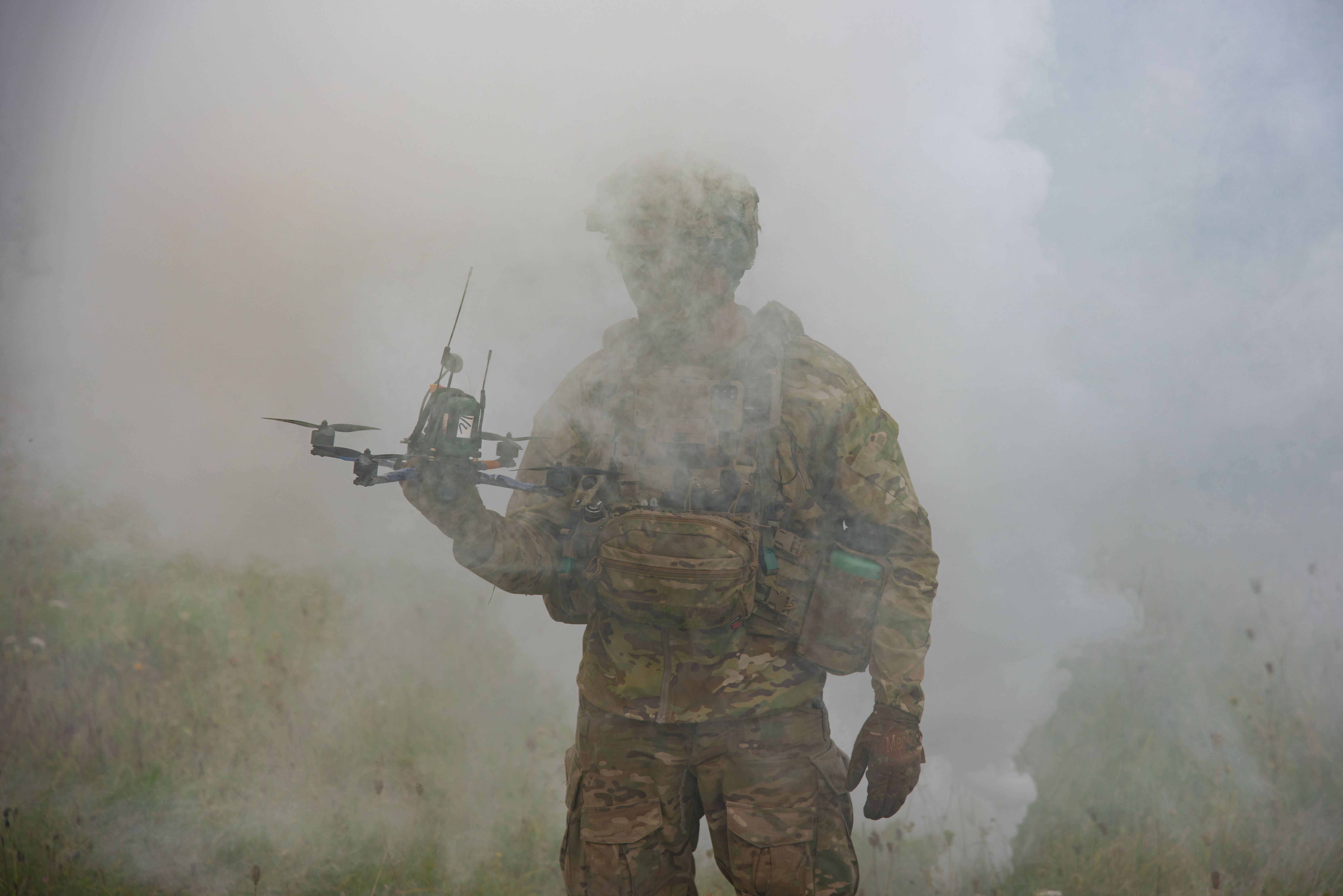
During an exercise called Project Sandhills 2.0, soldiers planned flight routes and operated Bumblebee V2 small unmanned aircraft systems at Range 63. The project was designed to test how drones could support breaching under contested conditions, meaning conditions in which an enemy is actively trying to stop the operation. Soldiers and industry partners collected feedback to help shape future Army capabilities. The purpose of such experiments is not only to prove that the equipment works, but also to find out how soldiers should use it in practice, which is often where new technologies succeed or fail.
A New Army Command for Autonomous Warfare
The Army's organizational response came quickly. A day after Hegseth announced a new four-star military command for unmanned and autonomous warfare, the Army ordered the creation of its own command for autonomous systems. A four-star rank is held by a general, the highest rank in the US Army, and a command at that level signals a significant institutional commitment.
According to the report, an Oct. 1 memo signed by Acting Army Secretary Adam Telle directs the Army vice chief of staff to establish the U.S. Army Futures and Autonomous Systems Command, known as FASCOM. The memo also tells the assistant secretary of the Army for acquisition, logistics and technology, the official who oversees how the Army buys weapons, to place one office in charge of purchasing its priority autonomous systems. Putting purchasing under a single office can make it easier to avoid overlapping contracts and to move faster from testing to buying, which is one of the central problems that military buyers have long faced. How FASCOM will be staffed and funded has not been detailed in the source material.
Drone Marketplace Expands to Allied Nations
The Army is also widening access to its online marketplace for rapid drone acquisition. Military Times reports that representatives of Canada, Croatia, Egypt, Japan, Kuwait, Morocco, Albania and Panama signed a statement of intent to join the Unmanned Aircraft Systems (UAS) Marketplace during a ceremony on Tuesday. A statement of intent is a formal expression of interest and cooperation, and it does not by itself commit funds. The report notes that the Army's headline on the expansion refers to 33 nations, while the ceremony described in the article involved the eight countries listed above.
Since the marketplace was set up, it has processed $800 million in transactions, according to the report. A marketplace of this kind lets military units and partners buy commercial drones more quickly than traditional procurement, which often takes years. For allies, joining could mean faster access to tested equipment and shared standards, though the terms of participation have not been detailed in the source material.
Armed Drones and Laser Weapons Move Toward Fielding
Weapons development is moving alongside the buying push. Sig Sauer announced on Tuesday that a heavy-duty quadcopter carrying its new M250 light machine gun completed a test requiring it to identify and engage targets from the air. The company carried out the test with Israel Aerospace Industries, maker of the Fire Storm 250, a reusable drone that can stay airborne for two hours and is designed with a stabilized machine-gun mount. A stabilized mount keeps the weapon steady despite the drone's movement, which is essential for accurate fire.
Directed-energy weapons, which use focused beams of energy such as lasers rather than bullets, are another area of focus. The Army has targeted early 2028 for its first laser weapon under the Enduring-High Energy Laser (E-HEL) program to be out of testing and ready for counter-drone operations, Army officials told Military Times. In September, the Army awarded AeroVironment a $464.8 million contract for LOCUST X3, a modular, palletized high-energy laser system. According to AeroVironment, earlier generations of the LOCUST system are already fielded in operational environments, including at the US southern border. The first LOCUST X3 is slated for delivery by the fourth quarter of fiscal year 2027, and it will be mounted on the Joint Light Tactical Vehicle. The US government's fiscal year runs from Oct. 1 to Sept. 30, so that delivery target falls in mid-2027. Analysts often see lasers as attractive against small drones because each shot can be far cheaper than a missile, though the systems still face questions about power, weather and range.
What to Watch Next
Several developments will show whether the conference's emphasis on autonomy translates into action. The most important is whether Congress approves the roughly $50 billion reconciliation request, since that decision would determine how far the Pentagon can scale its autonomous weapons. Analysts will also watch how quickly FASCOM is established and who leads it, as well as whether the purchasing office it directs can move from testing to bulk orders. The growth of the UAS Marketplace, including whether the countries that signed the statement of intent formally join, will indicate how far the Army's buying model spreads among allies. Finally, the first LOCUST X3 deliveries and the E-HEL testing timeline will reveal whether directed-energy weapons can move from prototypes to fielded counter-drone defenses on schedule.
For readers, the central message from Washington is that the US Army is treating autonomy as a core part of its future force rather than an experiment. The coming months will show whether the funding, organization and procurement changes announced at the conference can deliver on that ambition.
Topics: US Army, Association of the United States Army, Pete Hegseth, Pentagon, Autonomous weapons, Unmanned aircraft systems, Counter-drone lasers, Military procurement
Sources: Military Times