
Arizona National Guard to Be First State to Field Gray Eagle 25M Drone
General Atomics says eight aircraft will arrive by September 2027 and four more by the end of 2029, giving the state a unit of 12 unmanned systems
By AXY Defense Desk ·
Key points
- The Arizona National Guard will become the first state to establish a unit equipped with the Gray Eagle 25M, according to General Atomics.
- The state is due to receive eight aircraft by September 2027 and four more by the end of 2029, for a total of 12.
- The Gray Eagle 25M is a modernized version of the Gray Eagle drone, first flown in December 2023, with a $389 million federal development contract awarded the same month.
- The National Guard aims to create a UAS company in each of its eight infantry divisions, and Congress has funded three Gray Eagle 25M guard units so far, according to the company.
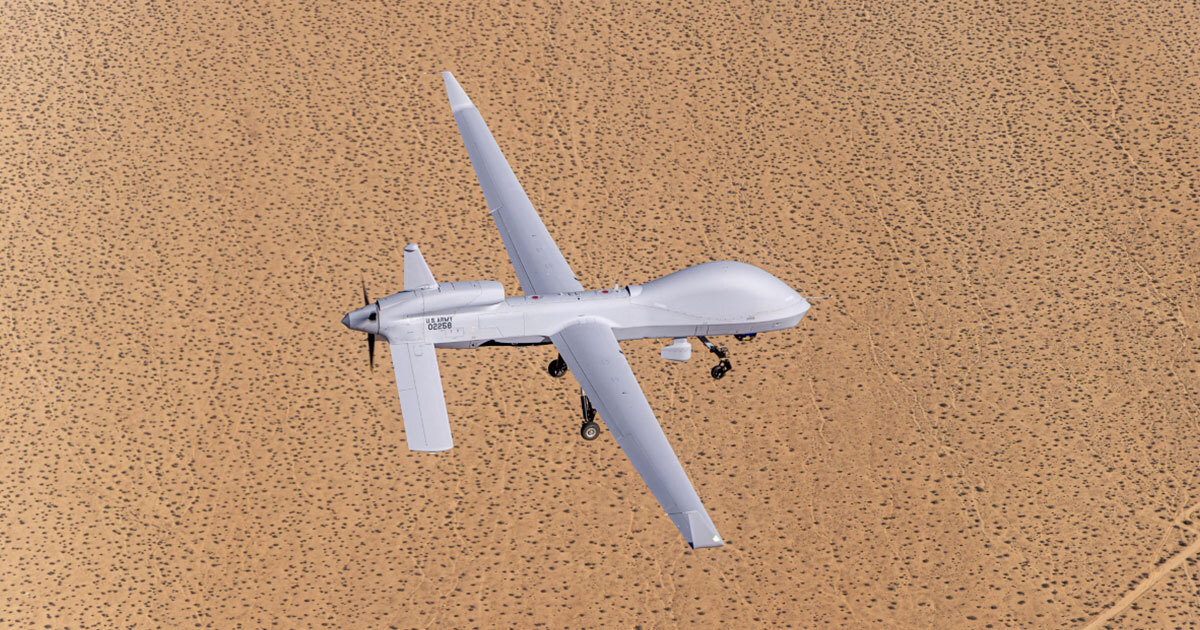
The Arizona National Guard will become the first state to establish a unit equipped with the Gray Eagle 25M, an unmanned aircraft system, or UAS, according to an announcement on Monday by General Atomics Aeronautical Systems, the company that manufactures the aircraft. The company said the Arizona Guard will receive eight Gray Eagle 25Ms by September 2027 and four more by the end of 2029, bringing the state's total to 12 of the drones. The announcement marks a milestone for both the Guard and the company, because it is the first time a state National Guard has been named as the first to field this specific version of the aircraft.
The Gray Eagle 25M is a large, remotely piloted aircraft that flies without a crew on board. Unmanned aircraft of this size are generally used for long-duration surveillance, reconnaissance and, in some configurations, strike missions. For a state military force, a drone of this class would give commanders a persistent view of a large area for hours at a time, which is why the system is closely watched by military planners and by the companies that build and supply it.
What the company says the drone can do
Patrick Shortsleeve, General Atomics' vice president of Defense Department strategic development, described the aircraft as "an integral part of the Army Aviation team." According to the company, the Gray Eagle works closely with advanced autonomy and manned rotary-wing systems, meaning helicopters and other crewed aircraft, to help forces outpace threats. In his statement, Shortsleeve pointed to the aircraft's safety record. "The Gray Eagle has a proven record of performance with 1 million hours of safe operations, including automatic takeoff and landing capability," he said. "When you factor in its extensive capabilities, the Gray Eagle is a cost-effective UAS that excels as an enabler for Fires, Maneuver, Network, and Intelligence operations."
These terms come from the Army's own vocabulary. In U.S. Army doctrine, Fires refers to the delivery of artillery, missiles and other weapons against targets, Maneuver refers to moving forces into position, Network refers to the communications systems that link units, and Intelligence refers to gathering and analyzing information about the enemy and terrain. When a company describes a drone as an enabler for these functions, it means the aircraft is intended to support those activities rather than act alone. The 1 million hours figure and the cost-effectiveness claim come from the manufacturer and have not been independently assessed in the source material.
Background on the Gray Eagle family
The Gray Eagle 25M is the newest edition of the Gray Eagle, a family of unmanned aircraft that has been in service for years. The original Gray Eagle was developed by General Atomics and has been used by the U.S. Army, which has relied on it for surveillance and other missions. According to the source material, the 25M made its first flight in December 2023. The same month, the federal government awarded General Atomics a $389 million contract to develop the system. Development contracts of this kind are typically used to design, test and prepare a new version of an existing platform for production and fielding, so the award suggests that the 25M was intended as a major upgrade rather than a minor change.
According to General Atomics, the "M" in the name stands for "modernized." The company says the aircraft now uses an open architecture design, advanced datalinks and a newer propulsion system. Open architecture is a term for a design that uses standard interfaces so that new hardware and software can be added or swapped without redesigning the whole aircraft. Datalinks are the radio connections that send commands to the aircraft and carry its sensor data back to operators. Propulsion refers to the engine and related systems that power flight. Together, these changes are meant to make the aircraft easier to upgrade over time.
The company says these improvements give the 25M a greater ability to modify its capabilities, resist electronic threats, carry more payload and remain in the air longer than its predecessor. Payload refers to the sensors, cameras or other equipment a drone carries. Resistance to electronic threats matters because modern militaries expect adversaries to try to jam radio links or interfere with navigation signals. These are company claims, but they point to the design priorities that have shaped the 25M.
Why the National Guard is getting drones of this class
The National Guard is a reserve component of the U.S. military that is organized into state, territorial and District of Columbia units. Each Guard force normally answers to its state's governor for domestic emergencies, while also being available for federal missions. Bringing an advanced drone into a state Guard unit therefore raises a question about how such a capability would be used in both roles, although the source material does not describe the Arizona unit's specific missions.
General Atomics says the National Guard's goal is to create a UAS company in each of its eight infantry divisions. The Arizona Guard is part of the 40th Infantry Division, which covers 11 other states or territories and is headquartered in California. In the Army's structure, a company is a sub-unit typically made up of around 100 to 200 soldiers, depending on its type, so the plan would spread drone capability across the Guard's infantry formations. The company also said that Congress has so far funded three Gray Eagle 25M guard units. The source material does not identify those other units or their locations, and this report does not assume them.
The model of giving drone companies to reserve forces is a way to expand capability without maintaining every unit at full active-duty strength. For a state force, a drone company can also provide training and experience that might later be used in federal operations.
What the upgrades could mean in practice
The company says that once fully operational, the Gray Eagle 25M can deploy in support of global missions for Combatant Command commanders. Combatant Commands are the regional and functional headquarters of the U.S. military that direct forces in their assigned areas. The company also said the aircraft can defend against threats in the Western Hemisphere. This suggests that the 25M is being presented not only as a training or homeland tool but as an asset that could be sent to different theaters, although the source material does not describe any planned deployments.
Analysts who follow the drone market typically expect the value of medium-sized unmanned aircraft to depend on how quickly they can be fielded, how much they cost to operate, and how well they can survive in contested airspace. A drone that can operate for long periods and carry different sensors can cover wide areas, but it also has to contend with air defenses and jamming. The 25M's stated focus on electronic resilience and open design reflects those concerns. Whether it performs as promised will become clearer as units train with it and as the Army and Guard report on its operations.
The automatic takeoff and landing capability that the company highlights is also relevant to operations. Automated flight functions can reduce the workload on crews and can make drones easier to operate from smaller or less developed airfields, though the source material does not describe the Arizona Guard's bases or runways.
What to watch next
Several developments will show whether the Arizona program moves forward on schedule. The first is the delivery of the initial eight aircraft by September 2027, which the company has set as a target. The second is the delivery of four additional aircraft by the end of 2029, which would bring the total to 12. Both dates are company announcements and could change as programs are tested and funded.
Another development to watch is the stand-up of the unit itself, including how it is staffed, trained and equipped. The National Guard's goal of creating a UAS company in each infantry division will depend on funding from Congress, which the company says has so far covered three Gray Eagle 25M guard units. Readers should also watch for independent assessments of the aircraft's performance, since the reliability and cost figures in the announcement come from the manufacturer.
Finally, the broader question is whether the Gray Eagle 25M will be used beyond training and domestic readiness. The company's remarks about global missions and the Western Hemisphere suggest that the aircraft is being positioned for a wider role. Until the Guard or the Army release more details about how the drones will be used, the Arizona announcement is best understood as a fielding and equipment milestone rather than a change in operational plans.
Topics: Arizona National Guard, Gray Eagle 25M, General Atomics, Unmanned aircraft systems, National Guard drones, U.S. Army Aviation, Military modernization
Sources: Defense News