
Alberta Begins Non-Binding Separation Vote Amid Military Base Fire Grief
Polls show most Albertans favor staying in Canada, but about a third back a binding vote and a possible separatist party is under discussion
By AXY Defense Desk ·
Key points
- Albertans began voting Monday, October 19, in a non-binding referendum on whether to pursue separation from Canada.
- Polling cited in the report shows 74% of decided voters favor remaining in Canada, while about 30% want a binding provincial vote on separation.
- The vote coincides with the mourning of four soldiers and injuries to dozens of others in a fast-moving military base fire.
- Premier Danielle Smith has said she would not hold another referendum while she leads the province if most Albertans favor staying in Canada.
- The next Alberta general election is scheduled for October 18, 2027, and separatist advocates are pushing for a binding vote and a possible new party.
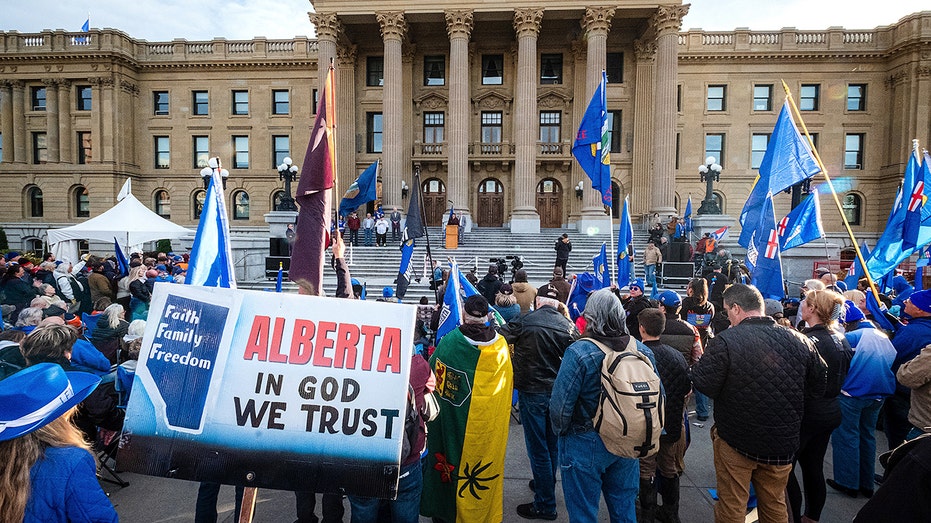
Residents of Alberta began voting on Monday, October 19, in a non-binding referendum that will indicate whether the western Canadian province should pursue separation from Canada, according to Fox News World. The vote is taking place while the province is mourning the deaths of four soldiers, and dozens of others were injured in a fast-moving fire that burned through a military base in Alberta. The source report does not describe the cause of the fire or name the base, and this report does not speculate on either.
Because the ballot is non-binding, a result would not by itself change Alberta's constitutional status. Any move toward independence would require a separate, legally binding process, and the outcome of this vote would serve as a political signal rather than a legal decision. The question has been on the agenda in Alberta for years, and the timing has drawn attention from national leaders as well as from people in the province who are focused on the military loss.
How the vote fits into Alberta's separatist history
Separatist sentiment in Alberta is not new. The province joined Confederation in 1905, and its economy has long been shaped by oil and gas, an industry whose development drew heavily on American capital. The source report notes that when oil was discovered in the 1940s, U.S. companies Chevron and Mobil helped develop what became Alberta's largest industry. Western alienation, a sense that Ottawa and central Canada make decisions that do not reflect western priorities, has periodically fuelled political movements in the province.
The most significant recent test of Canadian unity came in Quebec. Quebec voters rejected sovereignty in a 1995 referendum by a very narrow margin. Canada's Supreme Court later held in 1998 that a province could not secede unilaterally under the Constitution, and that a clear majority on a clear question would create an obligation for negotiations. Federal legislation passed in 2000, commonly called the Clarity Act, set out rules for how the federal government would assess such a question. These rules are relevant context for Alberta, because a non-binding vote is designed to test opinion without triggering that legal framework.
The source report cites Cory Morgan, a veteran separatist organizer who leads a group called Pathway to Independence and who led the short-lived Alberta Independence Party from 2000 to 2001. Morgan said that the vote will show that 'about one in three Albertans have had it.' He added: 'There is a big rift within Alberta and if things don't change, it will be a growing faction in this province.'
What the polls show
The source report cites an Abacus Data poll of 1,021 respondents, released on Saturday, which found that 74% of decided voters favor Alberta remaining within the Canadian Confederation. The same report says that the independence question will not go away for the nearly 30% who want Alberta's government to begin the process of holding a binding provincial referendum on separation. Morgan's group is the source of that estimate, and it is a figure from an advocate rather than an independent survey, so readers should weigh it accordingly.
A separate Abacus poll cited in the report found that 61% of the 1,021 surveyed expect Albertans will vote again on separation even if most choose to remain in Canada. The Angus Reid Institute, which released its own findings on Friday, reported that 62% of 1,010 Albertans it surveyed believe 'there will never be an end to the separatist movement' in the province. Taken together, these figures suggest that a majority of Albertans oppose leaving Canada today, while a large share expect the question to remain a recurring political fight.
The report also says that about 3 million Albertans are eligible to vote in the referendum. Polling of this kind measures opinion at a moment in time, and it does not predict how turnout or the final result will look. Analysts generally caution that the wording of a question, the level of turnout, and events during a campaign can all change how results are read.
Prime Minister Carney's warning and the U.S. factor
Prime Minister Mark Carney, who was raised in Edmonton, spoke at a 'Forever Canadian' rally in the city on Friday, according to the report. He told a crowd of more than 5,000 people that 'this referendum comes at the worst possible time.' He also said that 'the world is becoming more dangerous and divided [and] some outside our borders are working to break us so they can own us.' The report says this was an indirect reference to U.S. President Donald Trump's trade dispute with Canada and to his talk of annexing Canada.
The American dimension has become central to the debate. Morgan said that while 'a vocal minority' within the separatist movement favors Alberta becoming the 51st state, most pro-independence Albertans 'don't want to become a small fish in an even bigger pond.' He also said that 'Albertans in general are not too thrilled with President Trump right now and that makes them less inclined to leave the federation.' Earlier this year, Treasury Secretary Scott Bessent described Alberta as 'a natural partner for the U.S.' and Albertans as 'very independent people,' according to the report. Carney responded that he 'expect[ed] the U.S. administration to respect Canadian sovereignty.'
The report also cites a recent Globe and Mail account that Alberta separatist leaders met with Republican strategists in Calgary in January to look at software designed to identify and mobilize supporters, and that separatist leaders reportedly suggested exchanging water and oil for U.S. support when they met State Department officials in Washington last year. These claims are reported by the Globe and Mail as described in the source material and have not been independently confirmed in this report. For Canada's defense and security planners, the idea of foreign government support for a domestic separatist movement is a sensitive issue, and the source report does not indicate that any government has adopted a formal position on it.
Premier Danielle Smith and the United Conservative Party
Alberta Premier Danielle Smith told CBC News that if most Albertans support staying in Canada, she would not hold another referendum on the matter while she leads the provincial government. The report notes that she has said she will vote to keep the province in Canada. Alberta's next general election is scheduled for October 18, 2027, and Morgan argued that Smith could be out of her job by then.
The political background helps explain the stakes. Smith led the Wildrose Party, a conservative party founded in part by Morgan. That party merged with the Progressive Conservative Party of Alberta in 2020 to form the United Conservative Party, which Smith now leads. Morgan told Fox News Digital that more than half of the party's nearly 55,000 members support independence.
Angus Reid, founder and chairman of the Angus Reid Institute, told Fox News Digital that in the firm's recent polling, 67% of 293 UCP voters who support a future binding referendum on separation said they would either 'definitely support' or 'consider' supporting a separatist provincial political party. The report compares such a party to the Parti Quebecois, which the report says won the recent election in Quebec. Angus Reid said that an independence party in Alberta 'would probably spell the death of the UCP since it is so badly divided between separatists and non-separatists,' and could end Smith's career.
What to watch next
Several developments will determine whether this vote changes the direction of Alberta politics. The first is the official result and the turnout figure, which will show whether the separatist movement's support is growing or remains a minority view. The second is whether the provincial government moves toward a binding referendum, which the source report suggests separatist advocates are pushing for. The third is whether a separatist party is formed and how it performs in the 2027 general election.
The federal government will also be watching how the vote affects national unity and the broader relationship with the United States. The military losses and the base fire add a dimension that is not about constitutional law at all, because questions about defense readiness, the handling of the incident, and support for affected families will shape public reaction regardless of how voters decide on separation. Analysts expect that the emotional weight of the soldiers' deaths could influence voter attitudes in the short term, although the source material does not provide evidence of how it is affecting the vote.
For ordinary Albertans, the immediate stakes are political rather than practical, since the referendum itself does not change taxes, laws or citizenship. The longer-term consequences could be significant, however, if the debate leads to a binding vote, a new party, or a renewed fight over the province's place in Canada. Readers should watch official results from Alberta's electoral authorities and further reporting on the military incident as more details become available.
Questions and answers
What is the Alberta separation vote?
It is a non-binding referendum in which Albertans began voting on Monday, October 19, on whether the province should pursue separation from Canada. Because it is non-binding, the result would not by itself change the province's status.
Why is the Alberta referendum taking place now?
The source report says the vote comes as the province mourns four soldiers who died in a fast-moving fire at a military base, with dozens of others injured. The report describes the independence debate as an ongoing fight rather than a single event.
What do polls say about Alberta independence?
An Abacus Data poll of 1,021 respondents found 74% of decided voters favor remaining in Canada. Separatist advocate Cory Morgan said nearly 30% want the government to begin the process for a binding provincial referendum.
What happens next for Alberta separatism?
Separatist advocates want a binding provincial referendum, and Premier Danielle Smith has said she would not hold another referendum while she leads the province if most Albertans favor staying in Canada. The next general election is scheduled for October 18, 2027.
Topics: Alberta referendum, Alberta separation, Canada politics, Mark Carney, Danielle Smith, United Conservative Party, Canadian Confederation, Alberta separatist movement
Sources: Fox News World RSS