
Air Force Pauses Rappel Training After Airman Dies at San Antonio Stadium
The 6th Combat Training Squadron has halted all rappel and ropes events after Tech. Sgt. Ian Patterson died from injuries sustained during a demonstration at a UTSA football game
By AXY Defense Desk ·
Key points
- Tech. Sgt. Ian Patterson died after falling from the Alamodome's rafters during a rappelling demonstration before a UTSA game against the U.S. Naval Academy in San Antonio, Texas.
- The 6th Combat Training Squadron has paused all rappel and ropes training events and demonstrations until further notice, with no return date given.
- The rafters are around 170 feet above the stadium floor, well above the 100-foot height squadron members are trained to rappel from.
- The Air Force has not said when the pause began or who enacted it, and the incident is under investigation.
The U.S. Air Force has paused all rappelling and ropes training for the special operations unit of Tech. Sgt. Ian Patterson, less than a week after he died from injuries he suffered during a public rappelling demonstration at a college football game in San Antonio, Texas. The 6th Combat Training Squadron has suspended every rappel and ropes training event and demonstration, and the pause has no end date.
An Air Force Warfare Center spokesperson confirmed the decision in a short statement. "Tech Sgt Patterson's squadron, 6th Combat Training Squadron, has paused all rappel and ropes training events and demonstrations until further notice," the spokesperson said. The wording covers both the training that prepares airmen for real missions and the public shows that put those skills in front of crowds.
The fall happened on Saturday at the Alamodome in San Antonio. The University of Texas at San Antonio was hosting its annual Salute to Armed Forces & Veterans game against the U.S. Naval Academy. Videos from the event show Patterson, wearing combat fatigues, rappelling down toward midfield from the stadium's rafters. He then fell onto the field feet first and at full speed. Later videos show medical personnel attending to him on the field before he was taken to a local hospital.
Later that Saturday night, Nellis Air Force Base in Nevada, which houses the 6th Combat Training Squadron, announced that Patterson had died at the hospital from injuries sustained during the demonstration. A death linked to a public show in front of a full stadium leaves the Air Force with questions it will have to answer in public.
Who Tech. Sgt. Ian Patterson Was
Patterson was from Fort Stewart, Georgia, and had served in the Air Force for 15 years. He was a Tactical Air Control Party instructor assigned to the 6th Combat Training Squadron, Detachment 2, at Joint Base San Antonio, Texas. His decorations include the Air and Space Commendation Medal with three oak leaf clusters, along with the Army Commendation Medal, the Air and Space Achievement Medal and the Army Achievement Medal, each with one oak leaf cluster. An oak leaf cluster is a small emblem worn on a medal's ribbon to show that the same award was given again.
In 2022, Patterson was named the Air Force Special Warfare Enlisted Instructor of the Year at the headquarters level. Instructor awards recognize teaching, and that matters in a career where the people at the front of the room pass hard technical skills to airmen who will later be sent on demanding missions. His recognition also suggests that he was trusted to train others on the same skills that were involved in his death.
For a man with 15 years in uniform, the record points to someone who spent much of his career helping other airmen get ready. That is the context in which his death will be felt across the squadron.
Inside the Alamodome Demonstration
The sequence of events was fast and public. The game was the annual Salute to Armed Forces & Veterans event, a fixture on UTSA's schedule that recognizes the military community in San Antonio. Patterson's descent was meant to be seen. A service member dropping from the rafters toward the field is the kind of image a crowd watches closely, and that visibility is part of why such demonstrations are staged at games.
The height is the detail that stands out most. Members of the 6th Combat Training Squadron are trained to rappel from heights of 100 feet or more. The football stadium's rafters are around 170 feet above the stadium floor. Any review of the demonstration will have to explain why that height was chosen and how it was approved.
Training and public performance are different settings. Training is designed for learning, and the people running it control the conditions, the equipment checks and the pace. A public show is built around a game-day schedule, with a live crowd below and a visual goal to meet. Whether that setting changed the level of risk is one of the central questions now facing the Air Force.
Why the Squadron Stopped Its Rope Work
The spokesperson declined to say when the suspension began or who enacted it. The spokesperson also declined to say when the squadron expects its rappel and ropes events and demonstrations to resume. "Until further notice" means there is no return date, and the Air Force has not said what conditions would have to be met first.
For a unit whose work relies on rope skills, a pause has practical effects. Scheduled training sessions have to be reorganized, and any public appearance that involves rappelling is off the calendar for now. Rope training is usually built in stages, moving from lower heights and closer supervision toward more demanding work. A stop like this means the squadron has to decide where to resume and how to rebuild confidence in each step.
The pause also matters beyond the squadron. Other units that use rope skills will be watching how the Air Force handles the review, because the same equipment and techniques are used across special operations training.
What Tactical Air Control Party Airmen Train For
Tactical Air Control Party airmen, usually called TACP, are Air Force personnel who work alongside ground forces and help control air operations. Their work includes directing aircraft that support troops on the ground. That means they often need to reach difficult positions quickly and safely, and being able to move on rope and at height is one of the skills that makes that possible.
Rappelling and ropes are a large part of that skill base. An Air Force description of the career field says familiarization training is designed to give service members the basic information and techniques they need to conduct live operations. In plain terms, this is the foundation. Airmen learn how to handle equipment and move on a rope in controlled conditions before they are asked to use those same skills in real missions.
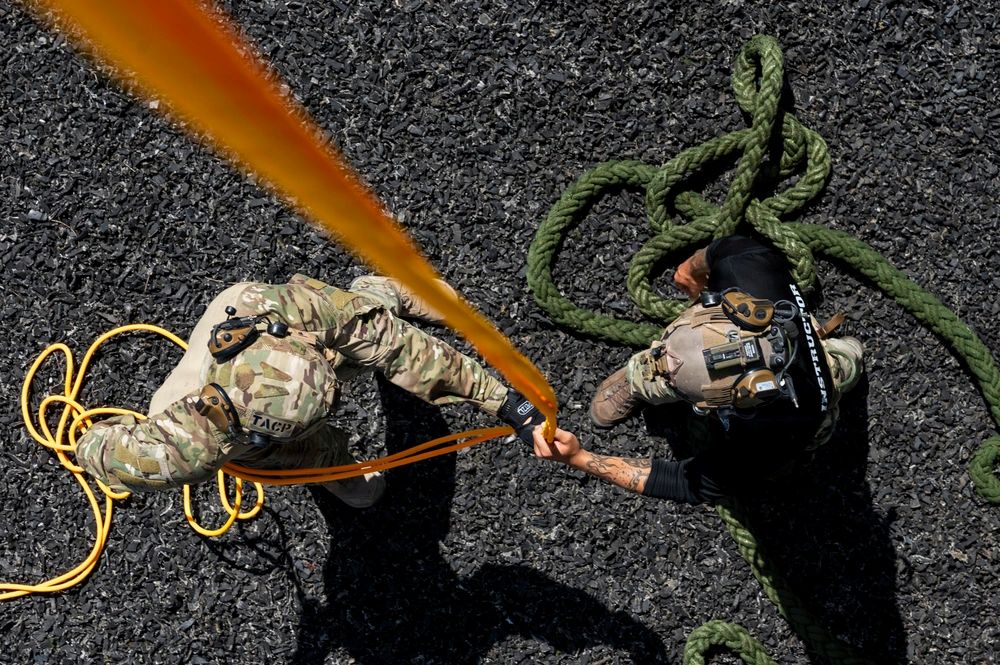
Rappelling means descending a rope, usually with a harness and a braking device that controls speed. The technique is simple to describe but demanding to do well, because the rope, the equipment, the anchor point and the person's control all have to work together. Each of those parts is a place where planning and supervision can either protect a rappeller or fail to do so.
What the Investigation Has to Answer
The incident is under investigation, according to a release issued when the airman was identified. That review will need to look at several areas: the equipment used, the planning behind the demonstration, how the descent was supervised, and the decision to carry out a rappel in front of a stadium audience. It is too early to say what the investigation will find. Still, each of those areas could shape how the Air Force handles similar events in the future.
The service may also need to decide whether public demonstrations of high-risk skills should follow the same rules as formal training. Shows help the military connect with people who may never see its work up close, and they can explain what airmen do to families and taxpayers. They also put skilled personnel in front of crowds in conditions that may differ from the controlled settings where they learned the job. That tension is the heart of the policy question.
If the review concludes that the planning or supervision fell short, the findings could lead to changes in how demonstrations are approved, who signs off on them and what height or setting is allowed. If it concludes otherwise, the Air Force will still have to explain why the event was judged safe enough to proceed.
What Happens to Rope Training Now
For now, the immediate effect is a pause across one squadron's rope work, with no return date. The next test is whether the Air Force announces conditions for restarting it, and whether it says how training and demonstration plans will be reviewed before anything resumes. Those answers will tell readers whether the pause is a short operational stop or the start of a broader reassessment.
Patterson's 15 years of service and his instructor recognition are part of why his death will be felt inside the unit. His death will be felt across a unit that depends on instructors like him to teach the next group of airmen how to use the same equipment safely. Families, colleagues and the San Antonio community that watched him fall will be waiting for the answers that the investigation is expected to provide.
Questions and answers
What happened to Tech. Sgt. Ian Patterson?
Patterson fell from the Alamodome's rafters during a rappelling demonstration before a University of Texas at San Antonio football game against the U.S. Naval Academy. Medical personnel took him to a local hospital, and Nellis Air Force Base later announced that he had died from his injuries.
Why did the Air Force stop rappelling training?
The 6th Combat Training Squadron has paused all rappel and ropes training events and demonstrations until further notice. The Air Force has not said when the pause began or who enacted it.
How high are the Alamodome's rafters?
The stadium's rafters are around 170 feet above the stadium floor. Members of the 6th Combat Training Squadron are trained to rappel from heights of 100 feet or more.
Is Patterson's death under investigation?
Yes. The incident is under investigation, according to a release issued when the airman was identified.
Topics: Air Force, rappelling, Tech. Sgt. Ian Patterson, 6th Combat Training Squadron, Joint Base San Antonio, Alamodome, Tactical Air Control Party, Air Force Special Warfare
Sources: Military Times